Jewish Wedding Customs and Traditions
Most Popular Days for a Jewish Wedding:
- In Talmudic times, Sundays and Wednesdays were considered the best days. Why? Because the courts met on Mondays and Thursdays (market days) and if there was a question of a bride’s virginity status, the husband could get up early the next morning and go to court. This stated in the Talmud, Tractate Ketubot 2a:1. Though, of these two days, Wednesday is preferred because it gives the groom extra days after Shabbat to prepare the wedding feast.
- Tuesdays are the 3rd day of the week (with counting beginning after Shabbat) which is also considered a prime Jewish wedding day. Why? On Day Three of Creation, God declared the world “good” twice. Therefore, it is an extra special day. (Genesis 1:1)
- Jewish weddings are not held on Shabbat, so Friday nights are out. Saturday nights are more challenging because of the need to wait until after Shabbat has gone out. Winter Saturdays are easier, while summer weddings on Saturday might need to begin after 9 or 10 p.m. in some places!
- Rosh Chodesh is also considered to be an auspicious time to get married as the cycle of the moon is also associated with fertility.
בְּתוּלָה נִשֵּׂאת לַיּוֹם הָרְבִיעִי וְאַלְמָנָה לַיּוֹם הַחֲמִישִׁי. שֶׁפַּעֲמַיִם בְּשַׁבָּת בָּתֵּי דִינִין יוֹשְׁבִין בָּעֲיָירוֹת: בַּיּוֹם הַשֵּׁנִי וּבַיּוֹם הַחֲמִישִׁי, שֶׁאִם הָיָה לוֹ טַעֲנַת בְּתוּלִים, הָיָה מַשְׁכִּים לְבֵית דִּין.
MISHNA: A virgin is married on Wednesday and a widow on Thursday. The reason for the former is that twice a week courts convene in the towns, on Monday and Thursday, so that if the husband had a claim concerning the bride’s virginity when consummating the marriage on Wednesday night, he would go early the next day to court and make his claim. (Talmud, Ketubot 2a:1)
*Generally, I try and use gender free language when introducing texts. However, in this case, the example is based on gender and gender roles at the time, so I felt it was integral to the text to retain the language.
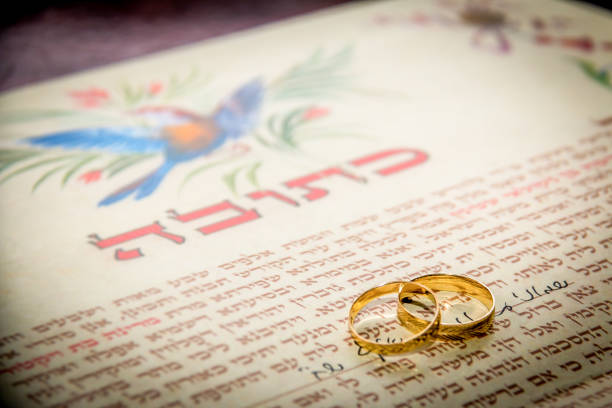
What Is a Ketubah?
- A Ketubah is a legal contract between two partners for their marriage.
- In Ancient times, a Ketubah was meant to protect the bride should things not work out. Almost like a prenuptial contract. How so? The Ketubah included the price of a dowry that was offered based on the virginity status of the bride. The Talmud specifies that “The Sages instituted the marriage contract for Jewish women: For a virgin two hundred dinars and for a widow one hundred dinars.” (Talmud, Ketubot 10a:1)
- The inclusion of a Ketubah for a wedding is a Rabbinic law, going back to the Talmud. (Talmud, Ketubot 10a:4)
- Wondering what to do about inflation or high cost of living? There’s teaching in the Talmud that talks about a case if a wedding takes place in Cappadocia, where evidently the money was more valuable. In this situation, the groom is obligated to pay the price in that currency. So, are New York Ketubahs worth more than North Dakota Ketubahs?
- Today, many couples choose to personalize their Ketubah and avoid mentioning a person’s virginal status at all. There are egalitarian versions, gender free versions, same-sex marriage texts, all English text, all Hebrew text, etc. Check them out at ketubah.com!
- Ketubah art is also very popular as tradition holds that a Ketubah should be displayed in the home.
Rabban Shimon ben Gamliel says that if a person marries in Cappadocia, where the currency is more valuable, and they divorce in Eretz Yisrael, payment for the marriage contract is from the money of Cappadocia. From the fact that they are obligated to pay the marriage contract in the currency of the place where they undertook the obligation, apparently the marriage contract is an obligation by Torah law. (Talmud, Ketubot10a:6)
Can a Wedding Be Private?
- There are some things in Jewish life that require 10 people, a minyan. Some of them include parts of the worship service, reading from the Torah, reciting the Mourner’s Kaddish, and the blessing of the wedding couple with the Sheva Brachot.
- Technically, the wedding ceremony that we know of today is comprised of two parts – Kiddushin/Erusin and then Nissuin. Kiddushin/Erusin was the betrothal part and Nissuin contains the Sheva Brachot and was the marriage part. They used to be separate, however as concerns about the length of time between the two and premarital sex arose, they generally became looped together. In most services today, the ring exchange and Ketubah happen during the first part and the Sheva Brachot is the center of the second. Kiddushin could be done without a minyan as there isn’t recitation of the Sheva Brachot, but Nissuin needs a minyan.
.תָּנוּ רַבָּנַן: מְבָרְכִין בִּרְכַּת חֲתָנִים בַּעֲשָׂרָה כׇּל שִׁבְעָה. אָמַר רַב יְהוּדָה: וְהוּא שֶׁבָּאוּ פָּנִים חֲדָשׁו
§ The Sages taught: One recites the benediction of the grooms in a quorum of ten men all seven days of the wedding celebration. Rav Yehuda said: And that is the case only when new faces who did not previously participate in the festivities came to join the celebration (Talmud, Ketubot 7b:1)
*While the Talmud is specific about ten men, there are many Jews who expand the concept of minyan to include 10 humans.
Sheva Brachot Celebrations:
- Just as the Seven Blessings are recited at a wedding (from the Talmud, Ketubot 8a:1-6), there is also a custom that the rejoicing with the wedding couple can continue after the ceremony.
- The week after a wedding, friends and family will often host a Sheva Brachot meal for the couple and the blessings are again recited after the Birkat HaMazon, blessing after the meal. It’s a way to keep the festivities going!
- It’s also another way to include people in the celebration who couldn’t be at the wedding itself.
Elements of a Jewish Wedding:
- A Chuppah is a wedding canopy under which the couple will stand as they are married. Traditionally it was made of a Tallit (prayer shawl) attached to four poles. In Ancient times, parents would plant cedar or cypress trees when a baby was born so that the wood could be made into Chuppah poles. The idea of a wedding canopy goes back to Biblical times.
אִסְפוּ־עָ֞ם קַדְּשׁ֤וּ קָהָל֙ קִבְצ֣וּ זְקֵנִ֔ים אִסְפוּ֙ עֽוֹלָלִ֔ים וְיֹנְקֵ֖י שָׁדָ֑יִם יֵצֵ֤א חָתָן֙ מֵֽחֶדְר֔וֹ וְכַלָּ֖ה מֵחֻפָּתָֽהּ׃
Gather the people, Bid the congregation purify themselves. Bring together the old, Gather the babes And the sucklings at the breast; Let the bridegroom come out of his chamber, The bride from her canopied couch. (Joel Chap 2:16)
- Today, Chuppot can be a creative element of a wedding. Quilt squares with messages for the couple can be created and stitched together. Florists can create a Chuppah out of fabric with poles wrapped in flowers and greens; there are many possibilities for personalizing this!
- Breaking of the glass is another often-recognizable custom. The idea of having something sad to temper our joy, even at a wedding, is a concept that goes back to Talmudic times.
Mar, the son of Rabina, made a marriage banquet for his son; when he observed that the Rabbis were at the height of their merriment, he brought in a very costly cup worth four hundred zouzim and broke it before them; and they grew sad. (Berachot 5:2)
- In later times, breaking the glass became a way to remember the destruction of the Holy Temple.
- A loud noise (like a crash) is said to be another way to keep the evil spirits away, so the glass breaking serves as a superstitious way of keeping evil away from the couple. And a great time to get everyone to shout, Mazel Tov!!!!