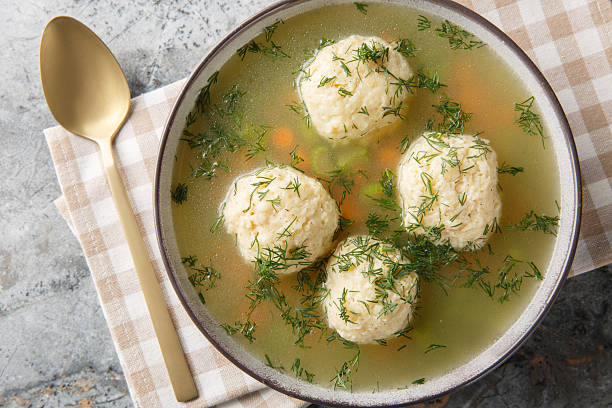
Soups and Stews in Jewish Life
True or False?
Matzah Balls have been a part of our staple Jewish diet for more than 500 years.
False! The first recorded recipe for ground matzah dumplings was printed in London in 1846. The first time they were referred to as matzah balls was in 1902.
All About Matzah Balls:
- Matzah balls are called matza knaidlach. Knaidel is a dumpling.
- While matzah balls in Jewish cuisine are relatively new, the idea of the dumpling isn’t as recent. By the 12th century the concept spread from Italy to Bohemia and then to other Slavic countries. This older version of the dumpling was made of bread.
- Over time, flour replaced bread as the main ingredient. German Jews (we can thank those early German Jews for LOTS of Ashkenazi staples such as potato pancakes, Mandelbrot, rye bread…) searching for something to make for Passover experimented with substituting matzah for flour.
- Crumbled matzah was the first iteration of this Passover delight. It wasn’t until the 20th century that Manischewitz made the matzah dumplings go viral by offering packaged matzah meal.
- The boxed mix from Manischewitz offered a uniform, inexpensive, reliable alternative to the matzah cracker dumpling and allowed the iconic balls to become Jewish comfort food.
- “Matzah balls for soup,” “Matzah Kloese,” “Matzos-Marrow Balls,” and “Cracker and Matzah Balls” were early names for these dumpling delicacies.
- Jewish comics helped popularize the matzah ball and garner them a home in Jewish delis.
- It didn’t take long for Matzah Balls to rise in popularity and become a Jewish staple food; the 1946 Roget’s Thesaurus included “Matzah Ball Soup” in its list of soups.
- Using matzah meal instead of flour and adding eggs makes for lighter dumplings.
- How one likes their Matzah Balls is subjective. Some add fat for more flavor; others add pepper or ginger for a little spice. ‘Sinkers vs floaters’ are also a topic of discussion at family meals.
- The most popular pairing for matzah dumplings is chicken soup. Though, if you cook the matzah balls directly in the soup it makes it cloudy, so they are frequently cooked in a separate pot of boiling water.
- Knaidlach can also be cooked in cholent, tzimmes, and pot roasts for a Shabbat treat.
- In a 2010 Forward article, trade secrets from Katz’s deli, 2nd Ave Deli, and Zabar’s mention the right ratio of oil, baking powder, and seltzer. (Note, baking powder makes them not-Kosher for Passover)
- Chicken soup, with or without matzah balls is often called Jewish Penicillin.
*Facts about matzah balls gleaned from The Encyclopedia of Jewish Food by Gil Marks
All About Cholent:
- Cholent is a slow simmered stew frequently made from a bean base that is served on Shabbat.
- The name is said to have come from French Ashkenazi Jews. In Western Yiddish spelled schalet and in Eastern Yiddish tsholnt. With the word probably coming from the old French word for warm.
- Cholent is a dish that addresses the requirement to avoid cooking on Shabbat. If cholent was half-cooked before Shabbat, then it could be left to finish on a low heat overnight and would be ready to eat for a warm, hearty meal after Shabbat morning services.
- Centuries ago, on Friday afternoons some Jewish communities, after the loaves of challah were pulled from the ovens, women and children (primarily) would bring their large cholent pots to the bakery where they would sit undisturbed overnight, finishing in the remaining heat from the oven.
- The only known ingredient from the French cholent was fava beans, though it was assumed that they also contained meat, grains and onions.
- Once dried haricot beans were introduced from America in the 15th century, this opened the door for white, kidney, pinto and lima beans.
- There are regional variations in cholent with some being vegetarian, some having wheat or rice, beef, chicken or goose and duck. Potatoes in cholent were a 19th century Polish Jewish addition. German Jews often added root vegetables.
- Cholent can be dry or watery or somewhere in the middle.
- Cholent tends to evoke a strong reaction among Jews. Some love it, some strongly dislike it, and many associate it with old time Jewish foods.
*Facts about Cholent gleaned from the Encyclopedia of Jewish Food by Gil Marks
The first mention of Cholent is said to come from Ohr Zarua, a 13th century Halakhic text that sheds light on the laws of Medieval European Jewish communities. In this reference, the Cholent, which had already been cooked and cooled, was kept near fires to keep it warm on Shabbat.
ראיתי בצרפת בבית מורי ר’ יהודא בר’ יצחק שפעמים מקררים צלנ”ט שלהם דהיינו טמון ובשבת טרם עת האוכל מדליקין העבדים אש סמוך לקדרות כדי שיתחממו בטוב ויש שמסלקין אותם ונותנים אותם סמוך לאש
I saw in France, in the house of my teacher Rabbi Yehuda, son of Isaac, that sometimes they refrigerate their Cholent, that is, they are hidden, and on Shabbat, before the meal, the slaves light a fire near the pots so that they warm up well. (Ohr Zarua, Volume II, Siman 8 — Translation from Google translate)
Lentils are the seeds of a small annual shrub and could have possibly been the first legume to be eaten. Its origins stretch before recorded history. There are mentions of lentils in Tanakh, including this story of Jacob and Esau as well as when King David and the people were served lentils as sustenance (II Samuel 17:28-29) and with the battle of the Philistines. (II Samuel 23:11-12)
וַיָּזֶד יַעֲקֹב נָזִיד וַיָּבֹא עֵשָׂו מִן־הַשָּׂדֶה וְהוּא עָיֵף׃ וַיֹּאמֶר עֵשָׂו אֶל־יַעֲקֹב הַלְעִיטֵנִי נָא מִן־הָאָדֹם הָאָדֹם הַזֶּה כִּי עָיֵף אָנֹכִי עַל־כֵּן קָרָא־שְׁמוֹ אֱדוֹם׃ וַיֹּאמֶר יַעֲקֹב מִכְרָה כַיּוֹם אֶת־בְּכֹרָתְךָ לִי׃ יֹּאמֶר עֵשָׂו הִנֵּה אָנֹכִי הוֹלֵךְ לָמוּת וְלָמָּה־זֶּה לִי בְּכֹרָה׃ וַיֹּאמֶר יַעֲקֹב הִשָּׁבְעָה לִּי כַּיּוֹם וַיִּשָּׁבַע לוֹ וַיִּמְכֹּר אֶת־בְּכֹרָתוֹ לְיַעֲקֹב׃ וְיַעֲקֹב נָתַן לְעֵשָׂו לֶחֶם וּנְזִיד עֲדָשִׁים וַיֹּאכַל וַיֵּשְׁתְּ וַיָּקׇם וַיֵּלַךְ וַיִּבֶז עֵשָׂו אֶת־הַבְּכֹרָה׃
Once when Jacob was cooking a stew, Esau came in from the open, famished. And Esau said to Jacob, “Give me some of that red stuff to gulp down, for I am famished”—which is why he was named Edom. Jacob said, “First sell me your birthright.” And Esau said, “I am at the point of death, so of what use is my birthright to me?” But Jacob said, “Swear to me first.” So, he swore to him, and sold his birthright to Jacob. Jacob then gave Esau bread and lentil stew; he ate and drank, and he rose and went away. Thus did Esau spurn the birthright. (Genesis 25:29-34)
Discussion Questions
- What role does Matzah Ball soup play in your life?
- Cholent – love it or hate it?
- What would you sacrifice for lentil soup?
- Of these three, which is your favorite soup?
- What if any emotional connections or reactions do you have to these soups/stews?
- Are soups/stews a source of comfort? Can they offer healing powers, and in what way?