Clay Meditation for Pottery Program
Clay Meditation
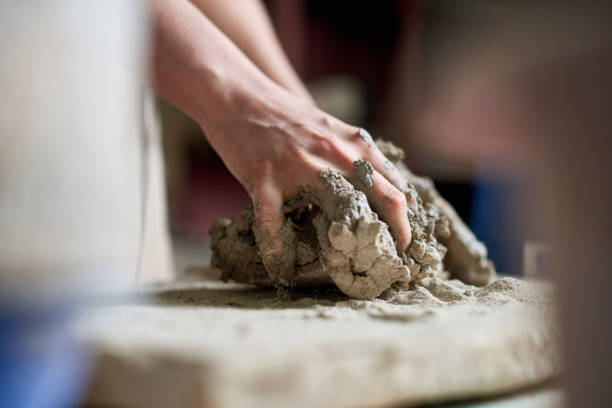
Give every participant a baseball-sized lump of moist, raw clay. Dim the lighting slightly if the studio allows, or choose a quiet corner of the room away from the noise of mechanical wheels.
Instruct everyone to close their eyes and just squeeze, roll, or press the clay. Just feel its weight, temperature, and texture. Read Jeremiah 18:3–4 aloud while they handle the raw clay: “So I went down to the potter’s house, and there he was working at the wheel. And the vessel he was making of clay was spoiled in the potter’s hand, and he reworked it into another vessel, as seemed good to him.”
- SAY: “Right now, your clay is pure potential. It listens to your hands completely. Think about a part of your life right now where you feel like you are in the raw, unformed stage: full of potential, but waiting for shape. Now image that you, like this clay, is being held.”
Next, ask participants to put the clay onto their wheel without turning it on. Tell them to try to sculpt a small vessel – a cup, a small bowl, or a simple container. Tell them not to use water to smooth out the surface. Let the clay pinch, stress, dry out a little, and form visible cracks.
Play or read the lyrics to Leonard Cohen’s Anthem while they work.
- SAY: “Look at your piece. Notice where the clay is pulling apart, where the edges are jagged, or where cracks are forming. In our lives, we exhaust ourselves trying to present a ‘perfect offering’: the perfect job, the perfect relationship, the flawless life strategy. Cohen reminds us that the crack isn’t a defect; it’s a prerequisite for the light. Now think of your own crack or vulnerability. Imagine it not as a failure, but as the place where your humanity shows through.”
Instruct everyone to take their vessel and completely squeeze it back into a ball. Crush the cracks out. Feel the clay become warm from their hands. Then, have them put it back on the wheel and add water. Encourage them to just play with the clay – bringing it up, squashing it down, forming and re-forming it.
Play a recording of Ki Hinei KaChomer while they work.
- SAY: “Ki Hinei KaCḥomer is an alphabetical acrostic poem traditionally sung as part of the Kol Nidrei service for Yom Kippur. We don’t know exactly where it’s from, though it’s thought to date approximately to 12th-century France. Each stanza of the poem offers a metaphor for the relationship between humanity and the divine: God is a master crafter or artist, and we are God’s handiwork. “Like a lump of clay in the hands of a sculptor. Like a piece of stone in the hands of a mason. Like a blade in the hands of a blacksmith. Like a curtain in the hands of an embroiderer.”
- SAY: “Even if a design is ‘spoiled’ or collapses, the material isn’t wasted. It can always be reworked. So too are humans. We are not fixed in stone. We are malleable. We are clay. Imagine that you are in the hands of the Ultimate Potter, or in the hands of time and growth. What part of yourself are you ready to let go of so you can be reshaped into something new?”
Play a second recording of Ki Hinei KaHomer before transitioning to the open studio portion of your program.