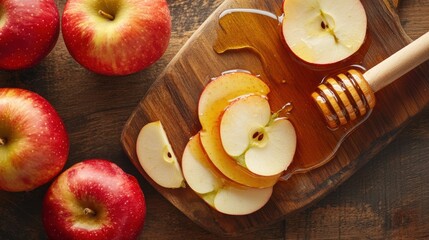
Dipping Apples in Honey
One of the very first mentions of eating apples on Rosh Hashanah:
From the Machzor Vitry, Laws of Rosh HaShanah 323:1
(Machzor Vitry is an 11th-century prayer book that incorporates legal rulings, composed by Rabbi Simcha of Vitry, a French scholar and disciple of Rashi.)
It is said in Pirkei DeRabbi Eliezer… Abaye said, “Now that you say that an omen is significant, a person should be accustomed to seeing at the beginning of the year gourds, leeks, beets, and dates.” From here, the people of France have the custom to eat red apples on Rosh Hashanah. And similarly, in Provence, they eat white grapes, white figs, and the head of a sheep. Every new, light, and good thing is for a good omen for all of Israel.
This text (below)from Tur: Orach Chayim takes the foods and customs of Rosh Hashanah into cool ways…
How to know whether it’s going to be a good year:
In the first chapter of Keritot, we have the text (Keritot 5b): Rabbah said, “That person that wants to know whether he will take out the year or not, should bring a candle during the ten days between Rosh Hashanah and Yom Kippur into a room where the wind is not blowing. If its light (its flame) continues, he will know that he will continue the year. And a person that wants to conduct a business deal and wants to know if the deal will be a successful one or not, should feed a chicken. If it becomes nicely fat, he will know that it will be successful…
What to eat:
Abbaye said,”Now that you have said that a sign is a [correct] matter, a man should accustom himself to eating citron, squash, beans (rubia), leeks (karti), beets (silkei) and dates (tamrei) on Rosh Hashanah.” Rashi explains that rubia is clover. Rubia – our merits should increase (yirbu); karti – (the enemies) should be cut off (yikaretu), etc.; silkei – removed (yistalku), etc.; tamrei finished (yitamu), etc.; squash because it is quick to grow.
Another Mention of Apples and Honey:
And from this grew the [various] customs, every place according to its custom; as in Germany, where they are accustomed to eating sweet apple with honey at the beginning of the meal, to say, “Let this new year be sweet for us.” And in Provence they are accustomed to bring all types of novelties [to the meal] and to eat a sheep’s head and lung, to say, “Let us be at the head and not at the tail;” and the lung because it is light. And our teacher, Rabbi Meir of Rothenberg was accustomed to eat the head of a ram to commemorate the ram of Yitzchak. (Tur: Orach Chayim: Siman 583)
*** What does citron mean in this text above
Its fruit before its leaves: Rabbenu Tam posed a difficulty, that behold we see that it grows like other trees! So he explained that tapuach (which is usually translated as apple) means citron (etrog). And (in the Targum,) we translate, “your breath is like tapuchim” (Song of Songs 7:8), as “like the fragrance of citrons”. And the fruit of the citron is before its leaves, since it resides on the tree from one year to the next. And after a year, the leaves of the previous year fall and new leaves come. And that is [the meaning of] its fruit [come] before – those leaves. (Tosafot on Shabbat 88a:8:1) —Therefore, this mention of citron has become a teaching that apples on Rosh Hashanah are important.
What kind of honey?
Generally, when we talk about Israel being a land flowing with milk and honey, we are thinking about date honey. So some say that apples and honey for Rosh Hashanah can be dipping apples in date honey. (Yum) Generally, though, bee honey has come to be associated with this custom.
Multiple ideas on what the apples and honey represent: Rosh Hashanah symbols: Apples and honey – The Jerusalem Post (jpost.com)
Blessing for dipping apples in honey:
בָּ רּוְך אַ תָּ ה יְיָּבָּ רּוְך אַ תָּ ה יְי,ָּ אֱֹלהֵֵֽ ינּו מֵֶֽ לְֶך הָּ עוֹלָּם, בוֹרֵ א פְּ רִ י הָּ עֵ ץ.
Baruch atah Adonai, Eloheinu melech ha-olam, borei p’ri ha-eitz.
We praise You, Eternal God, Sovereign of the Universe, Creator of the fruit of the tree.
יְהִ י רָּ צוֹן מִ לְּפָּ נֶָך, יְיָּ אֱֹלהֵֵֽ ינּו וֵאֹלהֵ י אֲבוֹתֵֵֽ ינּו וְאִ מּוֹתֵֵֽ ינּו,
שֶׁ תְ חַ דֵּ שׁ עָּ לֵינּו שָּׁ נָּה טוֹבָּ ה ּומְ תּוקָּ ה.
Y’hi ratzon milfanecha, Adonai Eloheinu v’Elohei
avoteinu v’imoteinu, shetchadesh aleinu shanah tovah um’tukah.
May it be Your will, Eternal our God, that this be a good and sweet year for us.