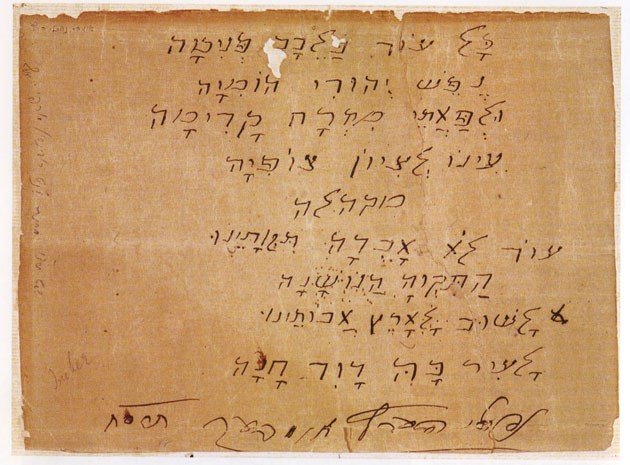
How Hatikvah Became Israel’s National Anthem
Introduction:
This program educates participants about the history of Hatikvah and the poem on which it was based, with special attention paid to the controversies surrounding it.
Materials:
- Two large posters, labeled “As long as…” and “We still have a chance to…”
- Markers to write on the posters
- Printed copies of the source sheet for each participant
- A way to play some music
Program Outline (about 1.5 hour):
- History Part 1: Origins (10 minutes)
- Poem Analysis (15 minutes)
- Music Analysis (10 minutes)
- History Part 2: Problems With Hatikvah (20 minutes)
- History Part 3: In the New Country (20 minutes)
- Journaling (5 minutes)
- Closing (10 minutes)
History Part 1: Origins (10 minutes)
- Read History Part 1 on the source sheet
- After 1st paragraph, ask: What was going on in the world during Imber’s lifetime? What was going on in this country? (Try to help participants put this era in context e.g., telephone invented, Civil War, Queen Victoria in England, cowboys, etc.)
- After 2nd paragraph, say: At this time, the land is called Palestine and is ruled by the Ottoman Empire, which was a Muslim empire based in modern-day Turkey.
- After 3rd paragraph ask: What does “not particularly political” mean in this context? What do you think they thought about the people who lived there?
Poem Analysis (15 minutes)
- Have participants read the poem, going around the room with each stanza. Then, put two posters up on the wall with these labels:
- “As long as…”
- “We still have a chance to…”
- After reading through the whole poem, re-read stanzas 1 and 8.
- Ask: What is the goal/hope of this poem? (Put these answers in the “We still have a chance at” section)
- Ask: Why do we need forgiveness from God? (We must have done something wrong, but what?)
- Ask: How is getting forgiveness from God connected to returning to the land? (ancient Jewish idea: controlling the land = we were following the rules; being conquered/others controlling the land = we messed up)
- Ask: According to this poem, what signs do we have that there’s still hope?
- Pull from the rest of the poem to fill out the “As long as…” section
- Explain: Since the Roman conquest in ~70 CE, Jews have been saying we must have messed up in some way, and we’re being punished by God by not having control over our own destinies. But there has been lots of debate about what we’re doing wrong. Some ideas include not being observant enough, being too assimilated, not taking care of the poor, not studying Torah, etc. etc.
- Ask: How does this poem move beyond those debates? What is Imber saying is necessary for hope?
- (According to Imber’s poem, what we need is just for certain things to exist, or for individuals to take emotional and intellectual actions. He is not saying that the solution is observance or justice or anything really big. And none of his solutions require all Jews to behave the same way.)
Music Analysis (10 minutes)
- Read the first paragraph from the “Music Analysis” section on the source sheet, then play this simple instrumental version of the melody.
- As you listen, prompt participants to pay attention to the vibe of the music. What emotions does it convey? Does it sound happy, sad, fun, serious, etc.?
- Try not to show any emotion during the video! After listening to the melody, ask them what they thought. Hopefully, they pick up on the minor chords, which we usually associate with sad songs.
- Questions for discussion:
- Think about the American national anthem, the Star Spangled Banner. Where do we hear this played? (Baseball games, military exercises)
- Can you imagine this song being played in those contexts? Where does it seem better suited? (e.g. military funeral instead of a victory)
- What are the advantages and disadvantages of a sad-sounding song for the early Zionist movement? Why do you think it resonated with some people? Why do you think other people really disliked it?
- Why might this the “wandering melody” theory resonate with Jewish history? (The song is from all over and doesn’t have a home, but it can find a home in eretz yisrael. Aww.)
- What is “spiritual resistance”? How would this song contribute to that “spiritual resistance”?
History Part 2: Problems With Hatikvah (20 minutes)
- Read History Part 2 on the source sheet.
- Make sure that participants understand and can articulate each of these objections. Then ask – do you agree? Why or why not?
History Part 3: In the New Country (20 minutes)
- Read History Part 3 on the source sheet.
- Questions for discussion:
- How were the lyrics changed from the original poem?
- Why do you think these changes were made? How do they affect the vibe of the song? (Try to encourage them to see how the song has been made less about archeological history and God – so it’s more secular. This is especially interesting because the country has become more religious over time.)
- “Not yet … free people” implies that, even with control of the land, the Jews are not yet free. What do you think that means? (Try to encourage them to see how this might encourage continued fighting for freedom, which can mean a lot of different things…)
- What message do you think it sends that, after almost 60 years, Hatikvah was officially adopted as the anthem, even though non-Jews and religious Jews don’t like it? What group is most represented by the song?
Journaling (5 minutes)
- Give participants a few minutes to journal on what they’ve learned about Hatikvah and how they feel it helps them understand the Zionist movement and/or the modern country of Israel.
Closing (10 minutes)
- Go around and share one new thing you learned about Hatikvah and why you think it’s interesting.