


Jewish Horror Movie Night
Part 1: Before the movie, review the background info on Jewish horror (at the end of this document) and then discuss together:
- What features do you enjoy in a horror movie? Why do you think that is?
- What, if anything, feels “too real” to explore in horror?
- What are you looking forward to about this movie?
Part 2: During the movie: Invite participants to pay attention to:
- What elements of the story, setting, or characters feel uniquely Jewish?
- Who is the real villain and who is the victim? Does this shift as the story unfolds?
- Are there scenes that feel like a metaphor for something bigger?
Part 3: After the movie, discuss together:
- What moment from the film is still sticking with you?
- What fear is at the heart of this story?
- Was there anything you found unexpectedly funny, cathartic, or moving?
- If you had to sum up the film’s “Jewish moral,” what would it be?
Background Info on Jewish Horror
Horror films are designed to scare, panic, or disgust, yet horror remains one of the most popular genres of filmmaking, perhaps because of the sense of relief that comes from having experienced ‘danger’ without ever actually being in danger. Horror allows us to confront these fears in a safe environment where we can release our anxieties by vicariously experiencing them through characters on the page or screen.
Whether evoking primal terror or exploring more subtle psychological themes, storytelling in the horror genre is always about tapping into our most primal fears. Horror movies often explore big concepts such as the fear of the unknown, isolation and alienation, loss and grief, and basic human concerns such as death and mortality.
So, what makes for Jewish horror? A film could use Jewish monsters (dybbuks, golems); explore Jewish fears (assimilation, destruction, antisemitism); or lean on Jewish themes like collective identity or the legacy of the past. It could also use imagery which is particularly frightening to Jews or subvert tropes of the genre, by having the “real monster” be the people who were there all along. As Jessica Price writes about The Golem (2018), “Everything seems to pale next to the very real, non-supernatural threat of human hatred… I sometimes wonder if that’s the only true Jewish horror genre out there.”
– adapted from “The Many Faces of Horror” by David Winter on Lightworks
WHAT TO WATCH:
The Golem (1920) – In 16th-century Prague, a rabbi creates the Golem out of clay. Using sorcery, he brings the creature to life to protect the Jews of Prague. (100% on RT)
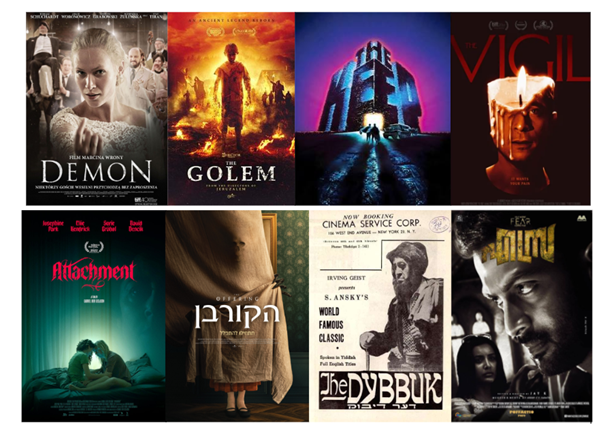
The Dybbuk (1937) – The mystical love story between Chonen, a poor Talmud student, and Lea, a girl from a wealthy family. A scary story made all the more horrible by the awareness of the disaster around the corner for the folk culture it depicts. (100% on RT)
The Keep (1983) – In this unfinished masterpiece, Nazis are forced to turn to a Jewish historian for help in battling the ancient demon they have inadvertently freed from its prison. The demon offers the historian a Faustian bargain in exchange for freedom.
Pi (1998) – A paranoid mathematician searches for a key number that will unlock the universal patterns found in nature. (88% on RT) Explores kabbalah and numerology.
The Unborn (2009) – When Casey Beldon witnesses a series of paranormal activities around her, a rabbi helps her uncover a family secret solely responsible for her condition. Explores Jewish monsters, Holocaust themes, and family trauma.
Demon (2015) – Over the course of his wild wedding, a groom is taken hold of by a dark force in this clever take on the Jewish legend of the dybbuk with a side of national guilt.
Ezra (2017) – A newly married woman brings an antique Jewish box into her home, unaware that the box contains the ghost of Abraham Ezra. (Indian Jewish community)
The Golem (2018) – During an outbreak of a deadly plague in Lithuania, a mystical woman must save her tight-knit Jewish community from a gang of ruffians led by a local landowner, but the entity she conjures to protect them is a far greater evil. (89% on RT)
The Vigil (2019) – A man providing overnight watch to a deceased member of his former Orthodox Jewish community finds himself opposite a malevolent entity. (90% on RT)
One Winter Night (2019) – An Orthodox Jewish mother and her daughters fall prey to the malevolent forces that preside over a rural community. Low-budget but good.
The Offering (2022) – The son of a Hasidic funeral director returns home with his pregnant wife in hopes of reconciling with his father. Little do they know that an ancient evil lurking inside a mysterious corpse has sinister plans for their unborn child. (76% on RT)
Attachment (2022) – Maja, a Danish has-been actress, falls in love with Leah, a Jewish academic from London. Leah suffers a mysterious seizure, and Maja returns with her to London. There, she meets Leah’s mother, Chana, a woman who could hold dark secrets. (95% on RT) Explores queer Jewish themes, interfaith relationships, and Jewish monsters.
Or, consider utilizing this Jewish Comedy Night source sheet for a program centered on one of these funnier films:
Young Frankenstein (1974) – An American grandson of the infamous scientist, struggling to prove that his grandfather was not as insane as people think, is invited to Transylvania.
Big Bad Wolves (2013) – After a little girl is brutally murdered, a suspect avoids arrest due to lack of evidence. Working separately, her father and a cop decide to do something about it. Israeli black comedy horror-thriller.
Hanukkah (2019) – A group of Jewish young adults are in for a Festival of Frights. With the help of a Rabbi, they deduce that they are being targeted because they have violated Judaic law and that their only chance of survival is to embrace their faith. Slasher.
Blood Relatives (2022) – A Yiddish vampire’s loner lifestyle is thrown into disarray when a teenager shows up claiming to be his daughter. Horror-comedy.