


Judith, Cheese, and Hanukkah
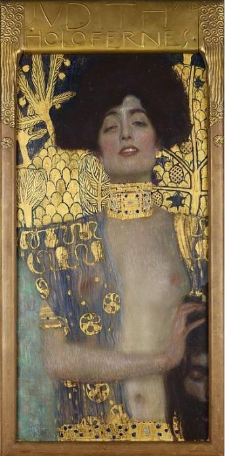
Painting of Judith holding Holofernes’ head.
Painted by Gustav Klimt, 1901
What’s The Story
- Judith isn’t mentioned in the first half of the Book of Judith.
- In the story, Holofernes, who was commander-in-chief of the Assyrian armies of Nebuchadnezzar, led a massive campaign against other neighboring countries, including Israel.
- Judith, the wise woman that she was, decided to take matters into her own hands to save her city.
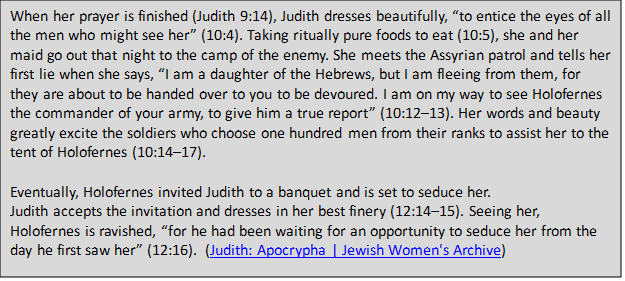
- In the second half of the book, Judith comes up with a plan to save the people and pleads with God to give her words that will harm those who plan to attack the Holy Temple in Jerusalem. (Judith 9:10 and 9:13)
Question to ponder: Is it me, or does this sound a bit like the story of Queen Esther and King Ahashverosh? Do you see similarities? Why do you think that is?
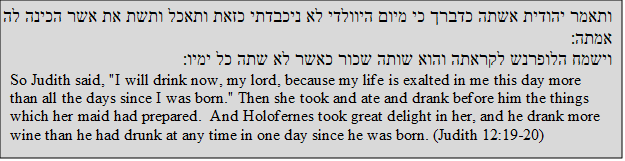
Judith’s Plan involved copious amounts of wine…
The commentary on these verses is that Judith brought her own Kosher foods since she was scrupulous in her dietary practice. One of the foods that she fed to Holofernes was a salty cheese. As Holofernes consumed all that salty cheese, he needed to wash it down with wine.
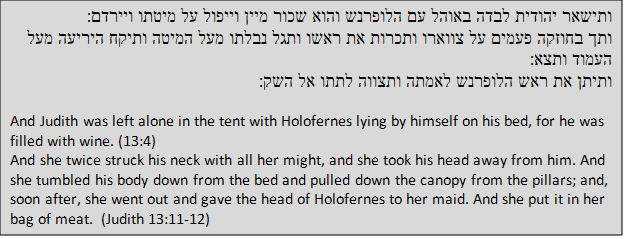
A reminder that too much alcohol can lead to reckless decisions
- Judith takes the head of Holofernes, shows it to the people, buoys their confidence and they are consequently successful in battle.
- There are different versions of Judith. The translation of the Vulgate (4th century Latin translation of the Bible.) is the version that fixes some of the inconsistencies between texts and makes Judith a heroine of Hanukkah. They are often called the Judith Midrashim.
- Rashi (11th century French scholar) alludes to Judith in his commentary on the Talmud (Shabbat 23a)

Rashbam (Rashi’s grandson, 12th century Biblical commentator) names her directly:

In the Shulchan Aruch, Orach Chayim we read of the connection to cheese (dairy) and Hanukkah:
Judith’s heroic deeds are often recounted on Hanukkah and offer a connection to dairy. Before the Eastern European Jews introduced potato pancakes for Hanukkah, dairy was the common ingredient in pancakes.
Questions to ponder: What do you think of Judith’s actions? Can you think of other connections between her story and the Hanukkah story?
Judith is often a subject of art in antiquity
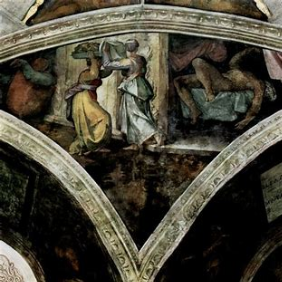
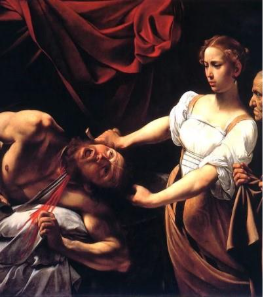
Caravaggio painting of Judith – around 1600
Michaelangelo painting of Judith and Holofernes in Sistine Chapel, circa 1508-1512