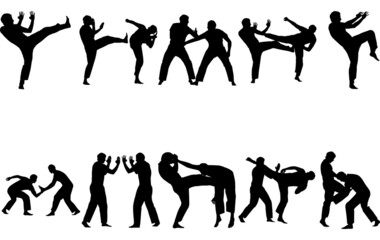
Krav Maga and Israel Origins
What is Krav Maga?
A Brief Look into the Methods of Krav Maga, IDF:
- Krav Maga was invented by Imi Lichtenfeld in the 1930’s as a response to antisemitism in Czechoslovakia.
- Krav Maga turns martial arts into self-defense.
- It combines elements of Judo, Aikido, karate, boxing and wrestling.
- Once Lichtenfeld moved to pre-state Israel in the 19040’s he went on to teach his form of self-defense to paramilitary fighters.
- In 1984, these paramilitary groups later became what we now know of as the IDF, the Israeli Defense Forces.
- Imi Lichtenfeld became the Chief Instructor for Krav Maga within the IDF.
- Krav Maga is not only effective with the military, but it has also because a form of civilian self-defense.
- Krav Maga stresses awareness and prevents danger before it starts.
- Krav Maga is well respected by other military groups like the US and British Air Forces who have incorporated the practice of Krav Maga.
Krav Maga and other forms of Martial Arts
Krav Maga moves and their Origins, IDF
Strikes; comes from karate and boxing
Takedowns and throws; comes from judo, aikido and wrestling
Groundwork; comes from judo and wrestling
Escapes from neck restraints and holds; comes from judo, aikido and wrestling
Empty-handed weapon defenses; from Aikido
More about the founder of Krav Maga
Imi Lichtenfeld – Biography — JewAge
- Imi Lichtenfeld was born in 1910 in Budapest and grew up in Bratislava, Czech. He died in 1998 in Netanya, Israel.
- His father, Samuel Lichtenfeld, worked on the Bratislava police force and was a former circus acrobat. He went on to work at a gymnasium and teach self-defense, which is where Imi learned his skills.
- Imi was a boxer and a wrestler.
- In the late 1930’s as antisemitism was rising throughout Eastern Europe, Imi and others in their neighborhood used their boxing and wrestling training to defend their neighborhood against gang violence. It was then that he realized his boxing and wrestling weren’t as effective for real life self-defense.
- Imi traveled to pre-state Israel in 1935 to compete in the Maccabi games but couldn’t compete because of a broken rib that he got from training.
- This injury helped him create the Krav Maga philosophy of ‘not getting hurt from
training’. - When he returned home to Czechoslovakia and faced difficult times on the streets because of antisemitism, he learned the differences between street fighting and sport fighting.
- He left Czechoslovakia in 1940 and arrived in Israel in 1942.The early fighters realized his abilities, and he began to train many within the Palmach, Haganah, and others.
- After teaching Krav Maga to the IDF for many years, he retired in 1964 and began to teach this technique to police officers and citizens.
- Imi trained teams of Krav Maga instructor and created the Israeli Krav Maga Association in 1978.
What does Judaism say about self-defense?
If the thief is seized while tunneling [tunneling Under a wall, for housebreaking]. and beaten to death, there is no bloodguilt in that case. If the sun had already risen, there would be bloodguilt in that case. — [The thief] must make restitution, and if lacking the means, shall be sold for the theft. (Exodus 22:1-2)
Rashi Commentary on Exodus 22:1-2
ם לו אין THERE SHALL NO GUILT OF BLOOD BE INCURRED FOR THEM — This is not regarded as a murder; it is as though (the thief) has been dead from the beginning of the criminal act (דמים לו אין is taken to mean: the thief, had no blood — no vitality). Here the Torah teaches you the rule: “If one comes with the intention of killing you, be quick and kill them”. — And this burglar actually came with the intention of killing you, for they knew full well that no one can hold oneself in check, looking on whilst people are stealing their property before their eyes and doing nothing. The thief therefore obviously came with this
purpose in view — that in case the owner of the property would resist them, they would kill the thief (Sanhedrin 72a).
- This text from the Torah is often cited as justification for self-defense and the need to protect oneself. What do you think as you read this text?
- Does Rashi’s commentary help explain it further?
- When is self-defense warranted?
- Are there different levels of self-defense?
- How can Krav Maga help us with the need to be prepared and defend ourselves and our community?
- Do you think the practice of Krav Maga has helped the IDF?