


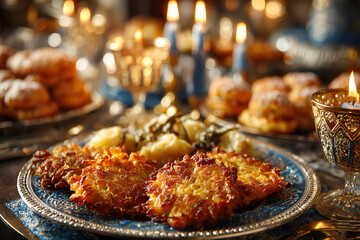
Food
Latkes: Did You Know?
Did you know?
- The word latke means “little oily” derived from Greek (eladia).
- The work latke also comes from the Ukrainian word for pancake, (oladka).
- The Modern Hebrew word for latke or pancakes, is levivot.
- The most common type of latke today comes from potatoes. It wasn’t necessarily a tradition from long ago.
- Ancient cooks used to put a little gruel on a stone to make a thin, plain cake. (Probably what we would understand as the pancake today, though, it wasn’t sweet).
- Pancakes first appeared among Ashkenazi Jews of Italy around the 14th century.
- Rabbi Kalonymus ben Kalonymus is credited with the first connection between pancakes and Hanukkah foods. He lived in Italy in the 14th century, 1286-1328 CE.
- Rabbi Kalonymus wrote about pancakes as a menu item for a Purim feast along with a poem about Hanukkah.
- After the Spanish Jews were exiled in 1492, they introduced ricotta cheese pancakes (cassola) in Rome.
- Cheese pancakes became the traditional Hanukkah dish because of the combination of cheese (see the story of Judith) and fried foods.
- In the winter in Northeastern Europe in the 14th and 15th centuries, soft cheese and the butter used to fry pancakes for Hanukkah were expensive, so rye flour and buckwheat were substitutes.
Where did potato pancakes come from?
- The French introduced the potato in the 18th century because of famine after the Revolution. Then, the Germans took hold of it and started producing potato flour and made grated potato cakes called reibekuchen.
- German Jewish potato pancakes were fried in geese schmaltz (fat) since that was the most common source of schmaltz back then.
- There was a class division when potatoes were introduced to German Jews. By and large it was a seen as a ‘poor persons’ food.
- Thanks to a series of crop failures in Ukraine and Poland towards the mid 1800’s when potatoes were planted in large quantities, they emerged as a staple of the Eastern European Jewish diet. Think of dumplings, knish, kreplach…
- The availability and cheaper cost of potatoes allowed them to take hold in Eastern European cooking.
- The potato pancake that we know of today came to American with the German immigrants in the mid 1800’s.
- The Settlement Cookbook, started by German Jews in Milwaukee, WI had a recipe for potato pancakes in 1901.
- In 1919, Aunt Jemima (now Pearl Milling Company) ran an ad in a Yiddish newspaper for the best flour for latkes. Crisco soon followed with an ad for itself as a tool to fry Hanukkah latkes.
- In 1927, Nettie Zimmerman helped the Latke achieve greater prominence in America with an article in the American Mercury Magazine. “Similarly, Hanukkah, to the Jewish bocher, meant not only yellow candles in a glistening menorah, but luscious potato latkes – pancakes made of grated, raw potatoes, mixed with flour and shortening and fried in schmaltz. Dozens of these were eaten by after-supper guests who came to participate in the Hanukkah revelry.”
- More modern cultural latke references: Isaac Bashevis Singer had a parakeet named Dreidel that ate latkes. Seinfeld had them appear in an episode in 1996, and in 1997, James Beard House held a Latke cook off for top chefs.
- *** Facts gleaned from The Encyclopedia of Jewish Food by Gil Marks
Lentil Latke anyone?
The Jerusalem Talmud has a description of ground lentils that are fried into pancakes.
HALAKHAH: Rebbi Yasa went to Rebbi Yose who brought roasted lentils out for him, ground them, formed them into a dough with honey, and fried them. He said to him, these are the ašišim mentioned by the Sages. (Jerusalem Talmud: Nedarim 6:10 vs 2)
Consider:
- Which do you think is superior, cheese or potato pancakes for Hanukkah?
- Are you a sour cream or an applesauce topping person for your latkes?
- Are latkes just for Hanukkah?
- What other styles of latkes have you tried?