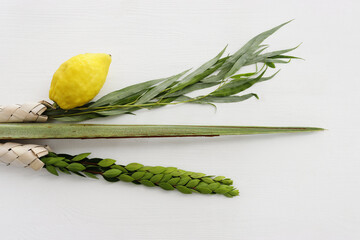
Local Lulav and Etrog Making
OVERVIEW:
On Sukkot, we are commanded to shake the lulav and etrog. This tradition is beautiful and fun but the carbon emissions it takes to import the lulav and etrog and their steep cost takes a toll on our environment and on our wallets. What if there was another way to engage with this awesome ritual?! This sukkot, explore the value of ba’al tashchit, refraining from needless waste or destruction by creating a locally sourced lulav and etrog! Learn about the symbolism of the lulav and etrog and unlock a new access point to this tradition that suits your budget and your local environment.
NOTE: This program could be run solely as a text learning program but the recommendation is to allow participants to assemble their own lulav and etrog
during the program. Depending on your location this could be paired with a hike in a local area or a visit to a farm or farmers market where plants can be
cut/cultivated/purchased. Additionally, consider applying for the Jewish Learning grant or the Jewish Culture and Holiday grant to receive funding to buy an array of local plants/fruits for participants to create their own lulav and etrog.
MATERIALS:
- Printed copies of the Local Lulav and Etrog SOURCE SHEET
- The four (local) species
- Damp paper towels (to wrap the stems to help keep the plants fresh)
- Optional: Ribbons/twine/bows
PROGRAM OUTLINE (40-90min):
- Welcome/Framing (10 min)
- Learning about the Lulav and Etrog (30 min)
- Creating our own local Lulav and Etrog (TBD)
PROGRAM DETAILS:
Beginning: Welcome/Framing (10 min)
- Welcome everyone! Do a go-around of names and pronouns.
- SAY: On Sukkot, its is a mitzvah to shake the lulav and etrog. This tradition is beautiful and fun but also a strain on the environment and our wallets. Judaism is a tradition deeply concerned with the way we care for the world. Jewish values of ba’al tashchit (pronounced bah-all tosh-kheat), refraining from needless waste or destruction and tikkun olam, repairing the world demand that we care for our earth. Yet, the lulav and the etrog are largely grown in the Land of Israel as monoculture, disrupting the natural ecosystems and emitting carbon emissions when the plants are shipped worldwide. Not only that, but, importing such a luxury item increases the price making it harder for lower-income people to participate in this mitzvah. What if there was another way to engage with this awesome ritual?! Today we are going to explore how we can create our own locally sourced lulav and etrog! We are going to learn about the symbolism of the lulav and etrog and unlock new access points to this tradition that work with our budgets and our local environments.
Middle: Learning about the Lulav and Etrog (30 min)
- Read through the source sheet as a group.
- Have different people read each source.
- Take time to answer the guiding questions and allow the discussion to flow from there!
- If you have a large group, consider breaking up into havruta pairs to learn the sources together and then take some time to answer a few of the questions as a group or share out overall reflections/questions.
End: Creating our own local Lulav and Etrog (TBD)
- Turn your learning into action! Here are some options for how to go about creating your own lulav and etrog.
- Follow up your learning with a hike in a local area where you can responsibly and respectfully cut local plants.
- Is a hike too far? Try a local park instead.
- Or support a local farm by making a trip there!
- Not an outdoorsy crew? Try a visit to a farmers market where local plants can be purchased.
- Too hectic to bring your community to a new location? Consider applying for the Jewish Learning grant or the Jewish Culture and Holiday grant to receive funding to buy an array of local plants/fruits. Bring them to your MoHo for participants to create their own lulav and etrog.
- SAY: Now we are going to turn our learning into action by doing [FILL IN ONE OF THE OPTIONS LISTED ABOVE] to cut/choose and create our own lulav and etrog! Cut or choose your four species [if you are cutting, especially in a public place, consider the tips for responsibly cultivating plants that we read on the source sheet and/or check out this VIDEO] and bind them together with a ribbon or with other plant materials!
- Not sure what plants to use for your local lulav and etrog? Check out these resources below:
- Rabbi Shoshana Friedman’s Guide for Making a Local Lulav
- Slides 4-7 are especially helpful in articulating the elements of each of the four species so that you can find comparable local species of plants.
- Slides 9-13 offer options for the four species that people have used in Massachusetts, North Carolina, Michigan, and California!
- This article by David A.M. Wilensky Getting Creative and Hyperlocal with your Lulav and Etrog offers some additional options for four species in other parts of North America.
- Rabbi Shoshana Friedman’s Guide for Making a Local Lulav
- Optional: If it is during sukkot, shake your lulav and etrog! To learn how to shake the lulav and etrog click HERE!