


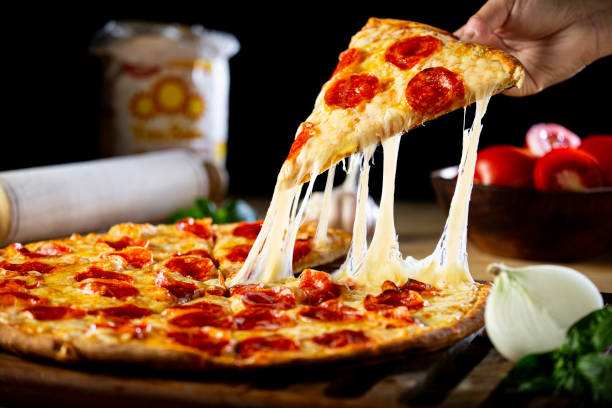
Pizza Party
ANCIENT TIMES: Matzah here, matzah there…
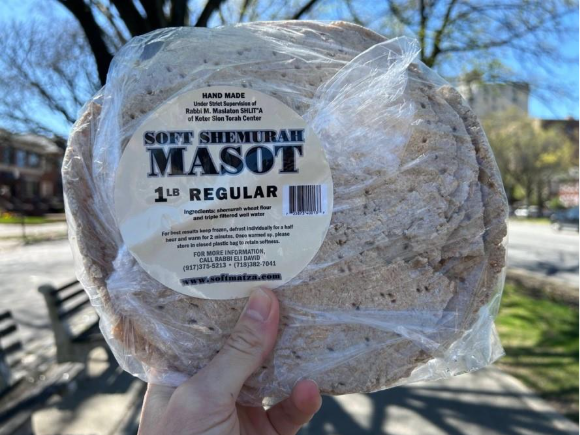
The hard, cracker-like matzah that most American Jews eat on Passover was only developed in the last few hundred years in Ashkenazi (European Jewish) communities. According to research from the Orthodox Union, for most of our history, Jews have eaten Sefardi-style matzah – which is softer and thicker, sort of like a pita – both on Passover, and as a cheaper and quicker alternative to bread throughout the year.
Ba’er Heitev, Rabbi Judah Ashkenazi, 18th century Poland:
| The Afikoman: It is also appropriate to wrap it in a napkin and place it between the pillow and the chair, and when [the Seder leader] wants to eat it, he should take it out as it was from inside the napkin and dangle it over his shoulder and walk a few paces and say, “This is how our ancestors walked, with the rest of [the matzah] bundled in their clothes!” | לַאֲפִיקוֹמָן….גַּם רָאוּי לְכוּרְכ’ בְּמִטְפַּחַת וּלְהַנִּיחַ בֵּין הַכַּר וְהַכֶּסֶת וּכְשֶׁרוֹצֶה לֶאֱכֹל יוֹצִיאָהּ כְּמוֹ שֶׁהָיָה בְּתוֹךְ הַמַּפָּה וִישַׁלְשֵׁל לַאֲחוֹרָיו וְיֵלֵךְ כְּמוֹ ד’ אַמּוֹת וְיֹאמַר כָּךְ הָיוּ אֲבוֹתֵינוּ הוֹלְכִים מִשְּׁאֵרוּתָם צְרוֹרוֹת בְּשֶׁמַּלּוֹתֶם |
“If we were to try all this with our matzah today, we would be eating matzah meal for afikomen! Clearly, the [ancient] matzah was more robust!”
– Rabbi Anthony Manning, Orthodox Union
- Does the Sefardi-style matzah remind you of something else? Could it be…pizza dough?
ROMAN TIMES: When in Jerusalem, eat as the Jerusalemites do
According to a tradition recorded in historian Abba Eban’s My People: The Story of the Jews, soldiers of the Roman Empire who were stationed in the land of Israel from 66-74 CE to quash the Great Jewish Revolt quickly ran out of shipments of Roman bread, and were forced to rely on local foods. Because the land was so impoverished, people could only afford to make and eat matzah, which the Romans found inedible – so they tried to improve the taste with cheese and olive oil.
To be fair, there are records of soldiers eating flatbreads with cheese going back to Persia in the 6th century BCE…but records from the time of the Great Jewish Revolt also show that Jewish children who lived in the city of Rome would often eat a cookie-sized matzah fritters called pizzarelle, which are still eaten by Roman Jews today.
MEDIEVAL TIMES: When a famous rabbi eats a big pizza pie, that’s the Rambam…
In 1983, Italian-Israeli professor published an article in the journal of the Italian Glottological Archive, arguing that Jews had introduced pizza to Europeans. In addition to some of the evidence cited above, she also shared that she had discovered the oldest known reference to pizza. Yehuda Romano, a 14th century Italian rabbi, had written a commentary on the Mishneh Torah, the influential Jewish law book written by the 12th century Spanish-Egyptian rabbi Moses Maimonides (also known as the Rambam).
Where Maimonides had written instructions for baking חררה – usually translated as flatbread –Rabbi Romano had written in the commentary, פיצה – pizza. Was this evidence that Jews had been eating pizza before everyone else – not only in Italy but even in Spain and Egypt?
Unfortunately, researchers in 2015 discovered a written reference to pizza that was 400 years earlier than Rabbi Romano’s: A 10th-century Latin code promising the donation of “twelve pizzas” to the bishop of Gaeta every Christmas and Easter.
MODERN TIMES: You say tomato, and I say tomato
Regardless of whoever invented pizza, it’s clear that until the modern period, they were missing a key ingredient: tomato sauce.
Tomatoes are not native to Europe and were brought from the New World in the early modern era. But tomatoes were not trusted by many Europeans. This is because they were widely believed to be poisonous. The fear was not entirely without merit. Tomatoes are technically part of the Solanaceae family of flowers, also known as nightshades. Many nightshade plants are known to be poisonous. Many people did start eating them eventually, but it took a while for it to really catch on everywhere. But a Sephardi-Jewish doctor later changed that….
It wasn’t accepted as an edible food until the work of the Jewish physician, Dr. John de Sequeyra, also known as Dr. Siccary by some, changed that. His family had lived in England but had once been court physicians to the Spanish and Portuguese monarchs. Sequeyra believed tomatoes to actually be healthy and could help prolong life, and had told this to American founding father Thomas Jefferson, as he was taking care of Jefferson’s father. An account in the American Jewish Archives details how Jefferson, following the teachings of Sequeyra, ate a tomato in public before a crowd and lived to tell the tale.
– Aaron Reich, The Jerusalem Post

NOW, I KNOW YOU’RE WONDERING:
Which blessing do I say over pizza?
This has actually been the subject of rabbinic debate for hundreds of years, because the rabbis don’t agree on whether pizza is a type of bread or a type of pie, and whether it counts as a meal or a snack. (One analysis from Yeshiva Har Etzion runs over 2,000 words). The general rule is that if you eat only one slice, you say “borei minei mezonot,” as you would for pie, but if you eat two or more slices, you say “hamotzi,” as you would for bread.