


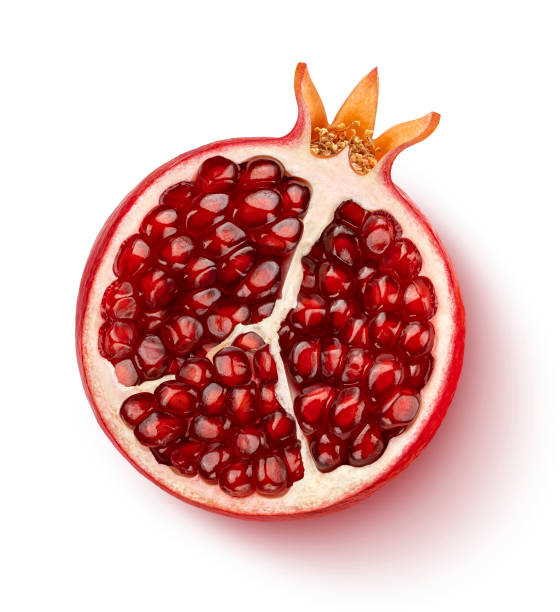
Pomegranates in Judaism
The foods listed in the source below are known as the Seven Species of the land of Israel. The Seven Species are often eaten on Tu Bi Shevat (the Jewish new year of the trees), Shavuot (the holiday when we celebrate the receiving of the Torah), and Sukkot (the harvest festival when we eat/sleep in huts) but some, like the pomegranate, also make appearances at other times of the year.
| Deuteronomy 8:7-9 | דברים ח’:ז-ט |
| For your God Adonai is bringing you into a good land, a land with streams and springs and fountains issuing from plain and hill; a land of wheat and barley, of vines, figs, and pomegranates, a land of olive trees and honey; a land where you may eat food without stint, where you will lack nothing; a land whose rocks are iron and from whose hills you can mine copper. | כִּי יְהֹוָה אֱלֹהֶיךָ מְבִיאֲךָ אֶל־אֶרֶץ טוֹבָה אֶרֶץ נַחֲלֵי מָיִם עֲיָנֹת וּתְהֹמֹת יֹצְאִים בַּבִּקְעָה וּבָהָר׃ אֶרֶץ חִטָּה וּשְׂעֹרָה וְגֶפֶן וּתְאֵנָה וְרִמּוֹן אֶרֶץ־זֵית שֶׁמֶן וּדְבָשׁ׃ אֶרֶץ אֲשֶׁר לֹא בְמִסְכֵּנֻת תֹּאכַל־בָּהּ לֶחֶם לֹא־תֶחְסַר כֹּל בָּהּ אֶרֶץ אֲשֶׁר אֲבָנֶיהָ בַרְזֶל וּמֵהֲרָרֶיהָ תַּחְצֹב נְחֹשֶׁת׃ |
- Why do you think pomegranates are specifically a part of the holidays listed above?
- Why might they also play a role in Rosh Hashanah?
| 9 Jewish Things About Pomegranates by My Jewish Learning |
| The pomegranate is often said to have 613 seeds, corresponding to the 613 mitzvot (plural of mitzvah) derived from the Bible. While this is not actually true (the number of seeds in each pomegranate varies widely), some have theorized that this belief stems from a misinterpretation of a passage in the [Talmud] (which concludes that even “the empty ones among the Jews are full of mitzvot like a pomegranate is [full of seeds.]” |
- What do you think about the way the Talmud compares pomegranates to people? Is this something you experience in your own life? What is the deeper meaning?
| How To Lead A Sephardic Rosh Hashanah Seder by My Jewish Learning |
| On the first and second nights of Rosh Hashanah…before eating the [festive] meal, [many] Sephardic and Mizrahi Jews partake in a longstanding custom: the Rosh Hashanah seder. The word seder is Hebrew for “order” and is a reference to the specific order…[that] blessings are recited…over simanim, or symbolic foods. The seder also includes festive songs, biblical readings and the recitation of piyyutim (liturgical poems). [The following is a version of the framing and blessing that might be said at a Simanim Seder] Pomegranate: At the Rosh Hashanah seder, [a pomegranate’s] many seeds represent the 613 mitzvot. The seeds can also symbolize the many blessings that we hope will manifest in the coming year. |
| יְהִי רָצֹון מִלְפָנֶיָך ה‘ אֱֹלהינּו וֵאלהי אֲבֹותֵינּו (וְאִמֹותֵינּו), שֶנִהְיֶה מְלֵאִים מִצְות כָרִמֹון Yehi ratzon milfanecha Adonai eloheinu v’elohei avoteinu (v’imoteinu), she’nihiyeh m’lei’im mitzvot ka’rimon. May it be Your will, Gd and the Gd of our ancestors, that we be filled with mitzvot like a pomegranate (is filled with seeds) |
- How does having a visual (and edible) symbol change the way you relate/react to this blessing?
| 9 Jewish Things About Pomegranates by My Jewish Learning |
| Pomegranates Traditionally Symbolize Fertility and Love. In Jewish tradition, pomegranates are a symbol of fertility and love, winning them frequent mention in, among other biblical texts, the Song of Songs [a piece of Jewish love poetry]. For example (Song of Songs 4:3): “Your lips are like a crimson thread; your mouth is lovely. Your brow behind your veil [gleams] like a pomegranate split open.” |
- Why do you think pomegranates are a symbol of love and fertility?
- Can you think of parallels/connections between pomegranates and other symbols of love or fertility?
| Pomegranates: 8 Jewish Facts for Rosh Hashanah published by Aish.com |
| In the days of the ancient Temples in Jerusalem, the Kohen Gadol – the High Priest who officiated in the Temple – wore a magnificent robe trimmed with 72 golden pomegranates (interspersed with 72 golden bells) hanging from the bottom of his robes (Exodus 34:34). These echoed a row of carved pomegranates near the Temple’s massive carved pillars. The Bible describes the architecture of the First Temple, built by King Solomon: He made pillars, two rows going all around…to cover the capitals (the tops of the pillars)…with the pomegranates” (I Kings 7:18) |
- Why do you think pomegranates are associated with the High Priest and the Temple in Temple times?