


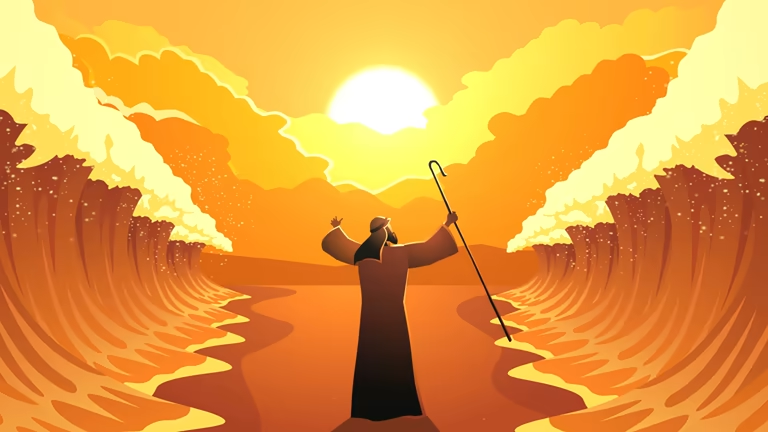
Prince of Egypt Movie Discussion
The Movie:
18 Thoughts I Had While Watching ‘Prince of Egypt’ for the First Time by Rachel Bernstein
My Passover prep and celebrations have always been consistent. I alternate between saying Passover and Pesach, I use the Maxwell House haggadah at my seder and I watch “Shalom Sesame Passover” — okay, that mostly happened when I was younger, but I stand by it being an excellent piece of Jewish culture! I
was staunch in my traditions (hi, Tevye!) and didn’t really see the need to add an animated film to the rotation during the holiday.
But it seems I may have been overlooking another important piece of Passover Jewish culture:The Prince of Egypt. Every year, friends routinely question why I
haven’t watched it, and even my Christian friends seem invested in the lore behind the film. I’m someone who is either way too early or way too late when it comes to trends, and it seems like for The Prince of Egypt, I’m the latter. So this year, I’m changing that. This year, I’m ringing in Passover season by watching The Prince of Egypt for the very first time.
Questions:
- The movie The Prince of Egypt was adapted into a musical, and both were very successful. What is the appeal of The Prince of Egypt movie and musical?
- What are the narrative benefits of telling the Passover story in musical form? What are the drawbacks?
The Story:
Exodus 2:11-15
Some time after that, when Moses had grown up, he went out to his kinsfolk and witnessed their labors. He saw an Egyptian beating a Hebrew, one of his kinsmen. He turned this way and that and, seeing no one about, he struck down the Egyptian and hid him in the sand. When he went out the next day, he found two Hebrews fighting; so he said to the offender, “Why do you strike your fellow?” He retorted, “Who made you chief and ruler over us? Do you mean to kill me as you killed the Egyptian?” Moses was frightened, and thought: Then the matter is known! When Pharaoh learned of the matter, he sought to kill Moses; but Moses fled from Pharaoh. He arrived in the land of Midian, and sat down beside a well.
- How does the portrayal of Moses in the movie compare to the Torah?
- What are the implications of this portrayal?
Each Year:
Pesach Haggadah, Magid, We Were Slaves in Egypt
We were slaves to Pharaoh in the land of Egypt. And the Lord, our God, took us out from there with a strong hand and an outstretched forearm. And if the Holy One, blessed be He, had not taken our ancestors from Egypt, behold we and our children and our children’s children would [all] be enslaved to Pharaoh in Egypt. And even if we were all sages, all discerning, all elders, all knowledgeable about the Torah, it would be a commandment upon us to tell the story of the exodus from Egypt. And anyone who adds [and spends extra time] in telling the story of the exodus from Egypt, behold he is praiseworthy.
- How does reliving an experience each year add new layers of understanding and wisdom?
- As you have grown up, how has your experience of the Passover seder/story changed as you have changed?
- What are some ways you think you can get more out of the telling of the Passover story this year?