


Seven Species Cocktails Mocktails and Reflection
INTRODUCTION:
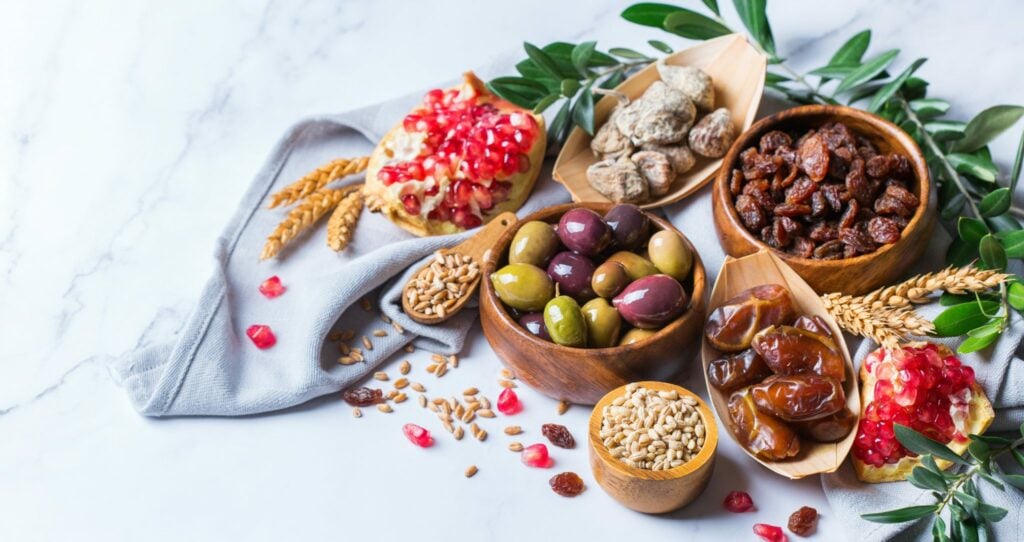
This activity introduces participants to the “seven species,” agricultural products mentioned in the Torah, sacred in Jewish tradition, and grown in the Land of Israel. As participants progress through the activity, they’ll learn a bit about each plant, enjoy a relevant cocktail/mocktail, and reflect on relevant themes. This activity is particularly well-suited for Sukkot, Tu Bishvat, or Shavuot, but can be used all year round.
MATERIALS:
- Small cups (5-10 oz is ideal)
- Blender
- Strainer
- Measuring cups and spoons
- Ice
- Before the event, make a batch cocktail or mocktail for each of the seven species. If using the recipe recommendations in this program, you will need:
- Barleywine beer such as Sierra Nevada Bigfoot
- Wheat beer (such as Blue Moon Belgian White)
- Olives
- Pitted dates
- Lime juice
- Lemon juice
- Simple syrup
- Maple syrup
- Apple cider
- Pomegranate juice
- Honey
- Sea salt
- Olive oil
- Cinnamon
- Black coffee
- Tequila or alternative
- White wine or alternative
- Triple sec or alternative
- Whiskey or Spice 94
- Extras, for fancier versions of the drinks:
- Agave syrup
- Rosemary
- Mint Leaves
- Sage Leaves
- Ginger ale
PROGRAM OUTLINE (40-60 minutes):
- Introduction (5 minutes)
- Cocktails/Mocktails and Reflection (30-45 minutes, depending on group size)
- Closing (5-10 minutes)
Introduction (5 minutes)
- The program facilitator should gather the group and share a bit about the seven species.
- For example: “The Seven Species (Hebrew: שִׁבְעַת הַמִינִים, Shiv’at HaMinim) are seven agricultural products that are listed in the Torah as being special products of the Land of Israel. In the Torah, Israelites are commanded to bring their first fruits – a portion of the first harvest of each of these species – as an offering to God. The 7 species are wheat, barley, grapes, figs, pomegranates, olives (or olive oil), and dates (or date honey). Wheat fields, vineyards and olive groves are still a salient feature of the local landscape today, and figs, olives, pomegranates and dates are common ingredients in local cuisine.”
- If running as a Sukkot event:
- Sukkot marks the final harvest of the year and was considered the last chance to bring those offerings to the Temple. Olives are the very last of the seven species to be ready, and so Sukkot was typically the only opportunity to bring the first olive harvest as an offering.
- If running as a Tu biShvat event:
- Tu biShvat marks the beginning of the agricultural year and the beginning of spring in Israel. In the Middle Ages, Kabbalists introduced the Tu biShvat seder, a sampling of each of these species, as a way to welcome the season.
- If running as a Shavuot event:
- Shavuot was considered “opening day” for this ritual: the first chance to bring those offerings to the Temple. The first of the seven species to be ready for harvest is barley, which is typically ready around Passover. By Shavuot, the first wheat is typically also ready for harvest. These bread bases, then, formed the first of the first fruits brought to the Temple.
Cocktails/Mocktails and Reflection (30-45 minutes, depending on group size)
Note: Feel free to switch up the order to make this activity work best for your group. As you’re passing out drinks, share the fact for each fruit. Then, ask the reflection question. Participants can sip on their drinks while sharing their answers.
- Barley
- Learn: The first of the seven species to be ready for harvest is barley, which is typically ready around Passover. In Kabbalah (Jewish mysticism), barley is connected with gevurah, or boundaries and strictness.
- Reflect: What is something you avoid, or don’t partake in?
- Drink: Barleywine beer such as Sierra Nevada Bigfoot (alc) or Gnarly Time Barley Whine (non-alc)
- Wheat
- Learn: Wild wheat is originally from modern-day Southern Lebanon, Northern Israel, and Western Syria. The archaeological record suggests that wheat was first domesticated around 9600 BCE – nearly 12,000 years ago.
- Reflect: What’s the oldest thing you own?
- Drink: Wheat beer (witbier) such as Blue Moon Belgian White (alc) or Athletic’s Wit’s Peak (non-alc)
- Grape
- Learn: While kiddush is traditionally recited over wine, almost any beverage can be used so long as it’s special or important – including beer, whiskey, tea and coffee. All you have to do is switch the blessing.
- Reflect: What’s something that you think has aged really well?
- Drink: White Sangria (non-alc, or add white wine)
- Fig
- Learn: The Torah doesn’t specify what fruit Adam and Eve ate in the Garden of Eden that got them kicked out, but fig is a popular theory because the Torah does say that they covered their nudity with fig leaves.
- Reflect: What’s your favorite Torah story?
- Drink: Rattlesnake’s Revenge (non-alc, or add whiskey)
- Pomegranate
- Learn: Jewish tradition teaches that each pomegranate has 613 seeds, representing the 613 commandments of the Torah. In actuality, pomegranates have a wide range of seeds, from around 200 to over 1,400.
- Reflect: If you could, what commandment would you add to the list?
- Drink: Pomegranate Mojito (alc) or Pomegranate Cinnamon Mocktail (non-alc)
- Date
- Learn: You may have heard of Israel as “the land of milk and honey” – most scholars think that the “honey” referred to is actually date honey, since bees were not popularly domesticated in that region.
- Reflect: What’s something that brought sweetness to your week?
- Drink: Date Delight (non-alc, or add gin)
- Olive
- Learn: Olives are the very last of the seven species to be ready, and so Sukkot was typically the only opportunity to bring the first olive harvest as an offering.
- Reflect: What are you feeling salty about these days?
- Drink: Dirty Margarita (non-alc, or add tequila)
Optional Extension: Kabbalah*
The Kabbalists explain that there is a much deeper significance to these fruits. Each corresponds to one of the seven sefirot (Divine emotive attributes):
- Wheat: Chesed—Kindness
- Barley: Gevurah—Severity, Boundaries
- Grapes: Tiferet—Harmony, Beauty
- Figs: Netzach—Perseverance, Victory, Eternity
- Pomegranates: Hod—Humility
- Olives: Yesod—Foundation
- Dates: Malchut—Royalty, Kingdom
Every soul possesses all seven of these sefirot. But for each person, one of these traits is most dominant, shaping the individual soul’s unique path to God. Thus, these seven fruits correspond to our serving G‑d with our personal attributes, as well as with all seven general modes of Divine service.
Wheat and barley usually make up the staples of our diet. So too, a balance of kindness and boundaries should make up the foundation/staples of our values. Traditionally, barley is considered the food of the poor and needy, while wheat was reserved for the wealthy.
The word for “grapevine” (גֶפֶן) in Hebrew stems from the same root as the word for “body” (גוּף). The grapevine calls upon us to look at the content and not just the packaging. The interior harbors a promise for the future that cannot always be seen from the outside.
The fig tree needs to be carefully watched. Once it is ripe, it will quickly spoil if not picked immediately from the tree. The sefirah of victory, which is also translated as eternity, is the one most related to time and therefore fits best with the temporal urgency found in the fig.
The sages state that even those Jews who seem void [of performing the commandments] are filled with good deeds like a pomegranate is full of seeds (the delicious fruit of the pomegranate). To understand that even the void is full of good requires us to realize that God and His goodness are truly universal and omnipresent.
The sages describe olives as causing memory loss, but olive oil as strengthening memory. The olive is the foundation of the Mediterranean diet. Yet the olive’s taste is bitter, and bitterness leads to forgetfulness of blessing. But olive oil is used for menorahs, which cast light and remind us of the blessings in our history and lives.
The date palm sings the verse, “The tzadik will blossom like a date palm.” The 70 date palm trees symbolize the 70 aspects of Torah that are revealed to those who eat of its fruit. Kingdom is described as the receptacle able to contain the light emanating from foundation. Likewise, every Jew is like a vessel shining with the holiness of the leader of the generation, considered the extension of Moshe Rabbeinu himself.
Closing (5 minutes)
Ask participants to share their favorite drink and favorite reflection question.
*from Chabad and Inner