


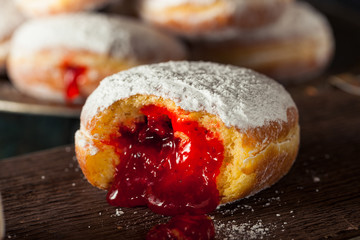
Jewish Holiday
Sufganiyot for Hanukkah
Where and when did the idea of doughnuts begin?
- The origin of the jelly doughnut is German, the name for it, Gefullte Krapfen.
- The first official mention of the jelly doughnut was in a 1485 cookbook called the Kuchenmeisteri and was printed on Johannes
Gutenberg’s printing press. (The same printing press that printed the first mass produced Bible!) - The early version was decidedly not kosher as it was jam spread in between two rounds of yeast dough and fried in lard.
- The original doughnuts were not necessarily sweet. They often contained meat, fish, mushrooms, or cheese.
- Doughnuts were often savory because sugar was so costly. It wasn’t until the 16th century and Caribbean sugar plantations that the price of sugar began to fall.
- A sugar beet factory in the 19th century helped roll out the idea of a yummy jelly filling.
- In the 1800’s the tasty jelly doughnut was generally just called a Berliner in Germany, except in Berlin and Saxony. By the late 1800’s they were called Bismarcken after Chancellor Bismarck. In Poland they were called paczki.
- Polish Jews started frying the jelly doughnuts in oil or shmaltz instead of lard, making them kosher; they called them ponchiks.
- Sephardi and Mizrachi Jews make fried pastries and doughnuts called bimuelos or lokmas.
- Ponchiks quickly became a favorite Polish Jewish dessert for Hanukkah.
How did Sufganiyot become an Israeli Hanukkah tradition?
- It was Polish immigrants who brought ponchiks to Israel for Hanukkah.
- Why on Hanukkah? The eating of foods fried in oil helps commemorate the “miracle of the oil” mentioned in the Talmud.
- In Israel, ponchiks took on the name sufganiya from a ‘spongy dough’ mentioned in the Talmud.
- It was the Histadrut, the Israeli Labor Federation, that helped make sufganiyot popular in Israel. 75 Percent of all Jewish workers in Mandatory Palestine were a part of the Histadrut. They decided that because sufganiyot were more difficult to make than latkes, it would provide more work for laborers, and they began the massive push to propel the doughnut. Companies began making and selling them weeks before Hanukkah.
- Some still have the tradition that they don’t eat a sufganiya until the first candle for Hanukkah.
- In 1995 culinary students at Hadassah College of Technology in Jerusalem made the world’s largest sufganiya, weighing 35lbs, 5lbs of which is jelly!
- The Guinness Book of World’s Records has their largest jelly doughnut being recorded in Utica, NY and weighing 1.7 tons!!!
- In Israel, it is estimated that between 18-24 million sufganiyot get eaten during the Hanukkah season. That’s like 3 per person.
- In 2009, the IDF purchased more than ½ million sufganiyot for soldiers to enjoy during Hanukkah!
*Facts gleaned from The Encyclopedia of Jewish Foods by Gil Marks
Consider:
- Do you think you would like a savory sufganiya?
- Does your family have a doughnut tradition for Hanukkah?
- Do you estimate that you consume more or less than the 3 sufganiyot per person average in Israel?
- What is your favorite sufganiya filling?
Sweet Sour
קצפת וניל, קולי מנגו אננס ופריזדריי מנגו קוקוס
Roladin is a popular Israeli bakery that goes “all in” with sufganiyot. There is also a Roladin in London.