


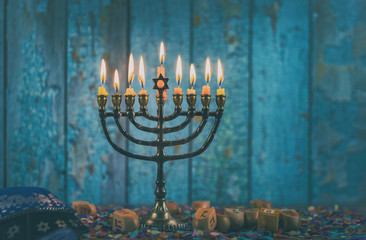
The Talmud on Hanukkah Candle Lighting
When should you light the Hanukkah lights?
The mitzva of kindling the Hanukkah lights is from sunset until traffic in the marketplace ceases. Does that not mean that if the light is extinguished, he must rekindle it so that it will remain lit for the duration of that period? The Gemara answers: No, the baraita can be understood otherwise: That if one did not yet light at sunset, he may still light the Hanukkah lights until traffic ceases. (Shabbat 21b)
What does that mean, until traffic in the marketplace ceases?
The expression until traffic in the marketplace ceases is mentioned here, and the Gemara asks: Until when exactly is this time? Rabba bar bar Ḥana said that Rabbi Yoḥanan said: Until the traffic of the people of Tadmor [tarmoda’ei] ceases. They sold kindling wood and remained in the marketplace later than everyone else. People who discovered at sunset that they had exhausted their wood supply could purchase wood from them. (Shabbat 21b)
Balancing Reality with Jewish Practice
- Candle lighting is often before 5pm depending on when in the year it falls and where you are located. What should I do if I am not home from work by then? What does the above text say about this?
- If some of the roommates aren’t home from work at candle lighting and you all want to light together – perhaps look at this text and consider waiting until you are all home.
- What does this look like in a practical sense for where you live?
- This brings up the struggle of two different competing values. The value of community (ie, lighting with others) and the value of performing a mitzvah (ie, lighting at sunset). Hanukkah is not the only time that happens… how do you reconcile this struggle in your life?
How many lights should we light?
The Sages taught in a baraita: The basic mitzva of Hanukkah is each day to have a light kindled by a person, the head of the household, for himself and his household. And the mehadrin, i.e., those who are meticulous in the performance of mitzvot, kindle a light for each and every one in the household. And the mehadrin min hamehadrin, who are even more meticulous, adjust the number of lights daily. Beit Shammai and Beit Hillel disagree as to the nature of that adjustment. Beit Shammai say: On the first day one kindles eight lights and, from there on, gradually decreases the number of lights until, on the last day of Hanukkah, he kindles one light. And Beit Hillel say: On the first day one kindles one light, and from there on, gradually increases the number of lights until, on the last day, he kindles eight lights. (Shabbat 21b)
Gosh, how do I know who to follow? Are we like Hillel or Shammai?
Rabba bar bar Ḥana said that Rabbi Yoḥanan said: There were two Elders in Sidon, and one of them acted in accordance with the opinion of Beit Shammai, and one of them acted in accordance with the opinion of Beit Hillel. One gave a reason for his actions: The number of lights corresponds to the bulls of the Festival. And one gave a reason for his actions: The number of lights is based on the principle: One elevates to a higher level in matters of sanctity and one does not downgrade. (Shabbat 21b)
Holy Discourse
- The disagreements between Hillel and Shammai are legendary in the Talmud. In this case (as in most cases), we follow Hillel. One light on the first night, increase one light each night.
- Which argument do you think makes sense?
- The basic mitzvah says we need to light one menorah. Depending on how much you want to beautify the mitzvah, you can add additional menorot. How many Hanukkah menorahs do you include?
- The Talmud frequently includes the debates of what practice to follow. What does that teach us about discourse today? On a day to day basis, how do you imagine Hillel and Shammai related to one another?
Where should we place the Menorah when it is lit?
The Sages taught in a baraita: It is a mitzva to place the Hanukkah lamp at the entrance to one’s house on the outside, so that all can see it. If
he lived upstairs, he places it at the window adjacent to the public domain. And in a time of danger, when the gentiles issued decrees to prohibit kindling lights, he places it on the table and that is sufficient to fulfill his obligation. (Shabbat 21b)
Safety and Antisemistism
- As Jews today we are facing struggles with how public to be about our observance. On the one hand, we want to be ‘loud and proud.’ On the other hand, we don’t always know our neighbors or community, and danger can be real.
- Where are you at this year regarding observance and “publicizing the miracle of Hanukkah?”
- What are some suggestions to balance these two competing needs?
- Fyi, if you are putting your light outside, halakha (Jewish law) says to put it on the left so with your mezuzah on the right. This way one who enters the house is surrounded by mitzvot.
Where does the concept of the oil from Hanukkah come from?
The Gemara asks: What is Hanukkah, and why are lights kindled on Hanukkah? The Gemara answers: The Sages taught in Megillat Ta’anit: On the twenty-fifth of Kislev, the days of Hanukkah are eight. One may not eulogize on them and one may not fast on them. What is the reason? When the Greeks entered the Sanctuary they defiled all the oils that were in the Sanctuary by touching them. And when the Hasmonean monarchy overcame them and emerged victorious over them, they searched and found only one cruse of oil that was placed with the seal of the High Priest, undisturbed by the Greeks. And there was sufficient oil there to light the candelabrum for only one day. A miracle occurred and they lit the candelabrum from it eight days. The next year the Sages instituted those days and made them holidays with recitation of hallel and special thanksgiving in prayer and blessings.
Religious Battles vs. Miracles
- The idea of the oil burning, rededication, relighting lamps wasn’t included in the story found in I and II Maccabees.
- Why do you think The Rabbis included it in the Talmud?
- Much of the Hanukkah story talks about the battles necessary to safeguard religion, yet, the Talmud highlights the miracle of the oil. What do you make of this?
If you want to look at the Hebrew for all of the above texts, it can be found here: https://www.sefaria.org/Shabbat.21b.1?lang=b