


Trail of Tears Commemoration Day Programming
This guide offers support for observing Trail of Tears Commemoration Day. While this day specifically honors the Cherokee Nation, it’s a powerful opportunity to learn about the history of forced removal and the resilience of many Native American peoples. Themes of exile, displacement, and survival resonate deeply with many Jews’ experiences. Learning about Native American history also helps us understand the complex story of America itself and be more responsible citizens.
About the Trail of Tears
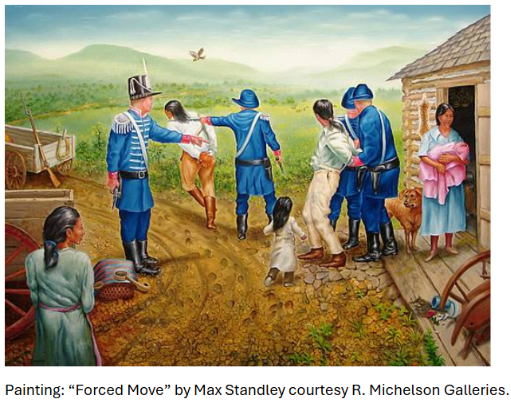
People with Cherokee backgrounds are spread out all over America, but prior to the arrival of European settlers, Cherokee people called South Eastern America home. They were forced out of their Native land on what is now known as The Trail of Tears. Since many Native Americans did not want to assimilate into European culture, the government came up with a plan to make land easier to claim from Natives and strongly encouraged Native Americans to migrate to the West.
After years of beratement from the government over land, a small group of Cherokee leaders reluctantly decided that removal was inevitable and negotiated with the government for the best possible treaty. Many Indigenous people opposed their removal and tried to resist, some moved peacefully and few were able to stay in their original state. Muscogee, Seminole, Chickasaw, Choctaw, Ponca and Ho-Chunk/Winnebago people were forced out of their Native land on what is now known as The Trail of Tears. Over 17,000 Indigenous people were forced to make the trek to Oklahoma and over 4,000 people – over 25% – died along the way. Many deaths were the result of starvation, disease and extreme exposure to the elements.
“The United States of America [put] old people in stockades — educated people, propertied people — and shipp[ed] them west… They endured unfathomable hardships and tragedy. Collectively, they never gave up and never relinquished the fortitude to continue another day… That determination, that history is buried inside each and every one of us that is Cherokee. We’re a proud people. We’ve got a lot to be proud of… Our people were stripped of everything, withstood generations of termination policies, and yet that fire to live and thrive would not be extinguished.”
– Bill John Baker, Principal Chief of the Cherokee Nation
Inspiration for Program Components
- Discover which Native groups live and lived in your area of residence
- Invite staff from an Indigenous-led nonprofit to speak about their work
- Order food from a local Native-owned business
- Learn about tribal sovereignty and indigenous governance
- Watch Intersections of Identity, a 1-hour program on the Jewish Indigenous experience
- Read a few poems about Jewish and Native experiences of exile, and discuss similarities and differences
- Watch this 1-hour program about historical trauma and cultural healing with experts from Jewish, American Indian, and African American communities.
- Read and discuss this article about Native Jewish identity
- Explore the range of Native and Jewish reactions to exile, including nationalism, tribalism, diasporism, and neo-sovereignty movements
- Read an excerpt from “The Stolen Beam,” an essay by a South Dakotan Jew reckoning with her family’s history (see below) or listen to the audio essay.