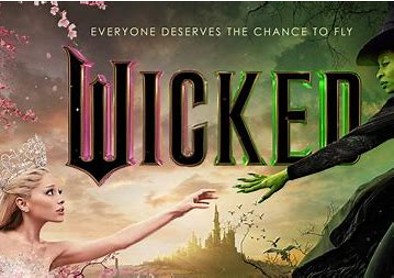
Wicked through a Jewish Lens
Background of Wicked:
Wicked is a 2003 Broadway Musical by Stephen Schwartz and Winnie Holzman. Both are Jewish.
It was based on the 1995 novel “Wicked: The Life and Times of the Wicked Witch of the West” by Gregory McGuire, who identifies as LGBTQ+.
Wicked was based on L. Frank Baum’s 1900 novel “The Wonderful Wizard of Oz”, also heavily based on political events of the time.
Idina Menzel was first cast as Elphaba in the Broadway show. Idina Menzel is Jewish. There have been many Jewish actresses who played Elphaba including Shoshanna Bean, Caissie Levy, Lindsay Mendez and Talia Suskauer.
The first black woman to play Elphaba was Alexia Khadime (West End 2008 – 2010). Cynthia Arivo plays Elphaba in the movie.
Some say that Elphaba represents Jews in Wicked. How so?
Elements of witches have long been associated with an antisemitic trope. Pointy hats, big noses, claw feet, horns, blood libel (poisons…)
Pointy Hat
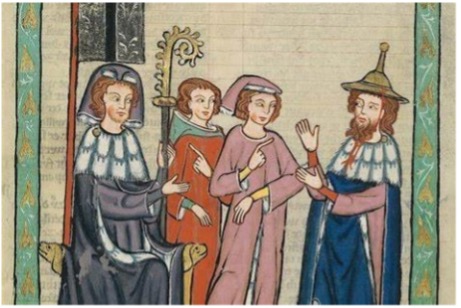
The pointy black witches’ hat could be traced back to a pointed hat that Jews had to wear in Medieval Europe called a Judenhut. First it was worn voluntarily, then after 1215, in some parts of the world Jews were forced to wear it to publicly identify themselves as Jewish. In many cases, the hat was yellow. Beginning in the 13th century, Jews were depicted wearing these hats in Medieval art.
Movie Question
When Glinda gave Elphaba the black pointy hat to wear, could it be taken as an overly antisemitic act to get her to wear something that depicted her as Jewish, or other?
Big Crooked Noses
“There was some overlap in the imagery [of Jews and witches], because you see a lot of [physical characteristics associated with witches] that were also stereotypes applied to Jews, before, during, and after the medieval period. This was the case with “aquiline” or “hooked” noses, which were used to depict both Jews and witches, this nose, which has been found to be a more broadly Mediterranean trait, was something that was used to signify differences between Jews living in Western or Eastern Europe and their non-Jewish neighbors who wouldn’t have had that Mediterranean ancestry,” (Quote from Vi, a youtube content creator and fashion historian with a channel called Snappydragon)
Taken from: Why Do Witches Wear Pointy Hats? The History Behind the Costume | HISTORY
More history of witches and antisemitism
“Why do witches wear pointed hats? Or have big noses? Or eat children? The answers, it may surprise us to learn, can be found in the history of antisemitism. Before witchcraft became a dominant scapegoat for misfortune in Europe, it was Jews who were often said to be demonic, evil individuals who poisoned wells, spread plague, and ate children.”
Taken from: the Salem Witch Museum exhibit – Witch Trials and Antisemitism: A Surprisingly Tangled History – Salem Witch Museum
Witches and ‘Othering’ in Wicked
“Indeed, the relationship between the witch archetype and antisemitism has many possible origins, histories, and understandings. However, it appears that medieval Jews and witches did indeed share a common struggle: the struggle of being othered, demonized, and persecuted based on Christian superstition, mythologization, and stereotyping.”
Taken from: The Antisemitic History of Witches – Hey Alma
Was Wicked written in reference to antisemitism?
“Author Gregory Maguire wrote “Wicked” after reading a headline in the 1990s which asked: “Saddam Hussein: The Next Hitler?” His reaction to reading that headline inspired him to think about human response to jingoism, which in turn inspired him to write the novel. As The Denver Gazette notes, the book “alludes to everything from Hitler’s Germany to Richard Nixon to the first Bush administration.” However, some have found specifically Jewish resonances in the book. The Gazette further reports, “The yellow-brick road was built by munchkin slave labor, the flying monkeys are the result of animal experimentation, and Oz is populated by a class-based society of oppressed animals. Scholars have equated these animals with Hitler’s Jewish victims, with Maguire’s blessing.” (However, I think it’s important to note that one could also read this as an allusion to American slavery and the Jim Crow South, where Black Americans were also enslaved, experimented on and oppressed.)”
Quoted in: Is Elphaba in ‘Wicked’ Jewish? – Hey Alma
Movie Question
During one of his lectures, Dr. Dillamond, the animal-teacher at Shiz pulls down the screen and sees the phrase, “Animals should be seen and not heard.”
Was the objective to silence the animals a reference to antisemitism and the silencing that educated Jews in 1930’s Europe faced?
About Wicked, the Forward says,
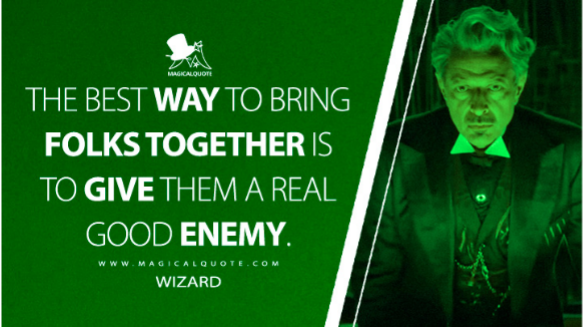
Wicked is a parable about how propaganda can be leveraged by authority figures, whether against Elphaba or the Jews, and the different forms it can take
Taken from: ‘Wicked’ is a parable about propaganda that evokes the Nazis – The Forward
Movie Question
Do you see this in the movie? Does this play out in society today? Do you see elements of Hitler and his propaganda machine depicted in the Great Oz?
Do the actresses who have portrayed Elphaba make the claim to stand up to othering?
(Idina Menzel and Cynthia Erivo)
While we don’t have conclusive evidence to say that Idina Menzel was cast as Elphaba because she’s Jewish, or that Cynthia Erivo was cast because she brings herself as a queer black person to the role, the fact that they were cast allows those who feel othered to see themselves in the show. It resonates because it isn’t about one specific othered group and is broad enough for many people to see themselves represented on screen. It highlights the intersectionality of the oppression of both blacks, Jews, and queers throughout history and provides us with role models who stand up for what is good and right. It proves to have a lasting impact because it resonates with so many minority groups.
Movie Question
Does having a Jewish, black, or queer person playing the role of Elphaba influence your perception as you watch the movie?
What is Good and What is Evil?
In Wicked and the Wizard of Oz, Glinda is portrayed as the good witch, while Elphaba is depicted as evil.
In Wicked, Elphaba was trying to stand up the animals against a great and powerful ruler out to get them.
Glinda, in Wicked, was unable to join Elphaba in her ultimate quest to save the animals; complacent to go back to Shiz and do what she could there.
Movie Question
How do their characters shake up the notion of good vs evil? Was either one truly good or truly evil?