


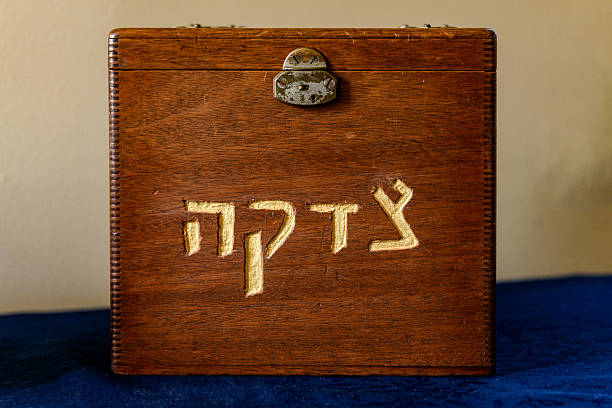
Tidbits on Tzedakah
Tzedakah from Reconstructing Judaism:
The word tzedakah, often translated as “charity,” comes from the Hebrew root tzedek, meaning “justice.” Its current usage was developed by the early rabbis, who recognized that the distribution of resources that results from a free-market economy must be adjusted by other means to ensure a fair society. Tzedakah is an expression of justice rather than mercy; its purpose is to create a fairer distribution of resources. Doing tzedakah restores justice.
- What does justice mean to you?
- How do you/would you like to contribute to a more just world?
Historic Roots of Tzedakah from Learning to Give:
In ancient times, the Hebrew Torah was intended for a primarily agricultural economy and addressed the tzedakah in agrarian terms. For example, at harvest time, the Torah instructs believers to leave crops standing in the corners of fields to allow the poor to reap needed food for survival. However, as the economy of the Near East diversified, rabbis addressed the tzedakah in financial terms. Public and private funds were created to help support people in need. Food banks and soup kitchens were developed at a time of no governmental assistance.
- Why do you think the Torah instructs Jews to leave crops standing in the corners of fields?
- How do you see the role of tzedakah evolving even in the present day?
Text of Unetaneh Tokef Prayer:
The line below is traditionally read during the high holiday season. As we ask Hashem and those around us for forgiveness we recite or hear this line and are reminded that the forgiveness comes more easily when we center our lives around these three things.
צוֹם קוֹל מָמוֹן וּתְשׁוּבָה וּתְפִלָּה וּצְדָקָה מַעֲבִירִין אֶת רֹעַ הַגְּזֵרָה
But Repentance (teshuvah), Prayer (tefillah) and Charity (tzedakah) avert the severity of the decree [from Hashem].
- Why do you think Judaism center these three things?
- What other things might you add to this list?
Who Should Give Tzedakah? Unpacked Judaism:
Jewish tradition generally holds that everyone has an obligation to give tzedakah, including those who are themselves in need. “Even a poor person who lives on tzedakah is obligated to give tzedakah to another,” Rambam wrote in the Mishneh Torah (Matanot Aniyim/Gifts to the Poor 7:5).
Why would a poor person be obligated to give tzedakah? According to Rabbi Jonathan Sacks, it’s because giving imparts dignity to the giver. “Tzedakah is not only directed to people’s physical needs but also their psychological situation,” he wrote. “The paradox of giving is that when we…give to another, it is we ourselves who are lifted.”
However, Rabbi Moses Isserles saw it differently, writing in the Shulchan Aruch (Yoreh De’ah 251:3), “One is not obligated to give tzedakah until one has a livelihood.” Meanwhile, in the Aruch Hashulchan (Yoreh De’ah 251:5), Rabbi Yechiel Epstein clarifies that those in need are obligated to give only a small amount of tzedakah each year.
- What do you think about obligating those who are in need to also give tzedakah?
- Why do you think there is a range of opinions on who should give tzedakah?
The 8 Different Levels of Giving Tzedakah by Rambam:
- The highest form of charity is to help sustain a person before they become impoverished by offering a substantial gift in a dignified manner, or by extending a suitable loan, or by helping them find employment or establish themselves in business so as to make it unnecessary for them to become dependent on others.
- Giving assistance in such a way that the giver and recipient are unknown to each other. Communal funds, administered by responsible people are also in this category.
- Donations when the donor is aware to whom the charity is being given, but the recipient is unaware of the source.
- Donations when the recipient is aware of the donor’s identity, but the donor still doesn’t know the specific identity of the recipient.
- When one gives directly to the poor without being asked.
- When one gives directly to the poor upon being asked.
- When one gives less than he should, but does so cheerfully.
- When donations are given grudgingly.
- Why do you think there are different levels of giving tzedakah?
- Which level feels the easiest and which feels the most challenging for you?