


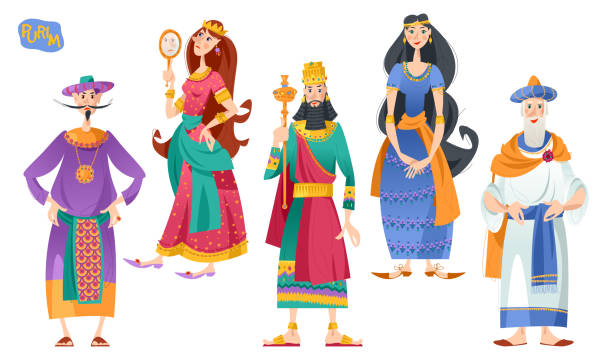
The People of Purim – What Would You Do?
Vashti:
Who she was: King Ahashverosh’s first wife who refused to dance before the king.
On the seventh day, when the king was merry with wine, he ordered Mehuman, Bizzetha, Harbona, Bigtha, Abagtha, Zethar, and Carcas, the seven eunuchs in attendance on King Ahasuerus, to bring Queen Vashti before the king wearing a royal diadem, to display her beauty to the peoples and the officials; for she was a beautiful woman. But Queen Vashti refused to come at the king’s command conveyed by the eunuchs. The king was greatly incensed, and his fury burned within him. (Esther 1:10-12)
Thereupon Memucan declared in the presence of the king and the ministers: “Queen Vashti has committed an offense not only against Your Majesty but also against all the officials and against all the peoples in all the provinces of King Ahasuerus. For the queen’s behavior will make all wives despise their husbands, as they reflect that King Ahasuerus himself ordered Queen Vashti to be brought before him, but she would not come. (Esther 1:16-17)
Questions to Consider:
- What would you do?
- Would you dance before the king?
- Would you protest?
- Would you trade it all in for the freedom to stand up for yourself?
- Does the command to dance violate Vashti?
Esther:
Who she was: The king’s second wife, the namesake of the Megillah, and the heroine of the story who used her inner strength to stand up to the King and defend the Jewish people.
From Mordechai to Eshter: On the contrary, if you keep silent in this crisis, relief and deliverance will come to the Jews from another quarter, while you and your father’s house will perish. And who knows, perhaps you have attained to royal position for just such a crisis. (Esther 4:14)
From Esther to Mordechai: “Go, assemble all the Jews who live in Shushan, and fast in my behalf; do not eat or drink for three days, night or day. I and my maidens will observe the same fast. Then I shall go to the king, though it is contrary to the law; and if I am to perish, I shall perish!” (Esther 4:16)
Questions to Consider:
- Do you speak or do you keep silent?
- Is this about your or the community?
- How do you approach the king?
Mordechai:
Who he was: Esther’s cousin (uncle/foster father) who refused to bow down to Haman and encouraged Esther to use her power to save the Jews.
All the king’s courtiers in the palace gate knelt and bowed low to Haman, for such was the king’s order concerning him; but Mordecai would not kneel or bow low. Then the king’s courtiers who were in the palace gate said to Mordecai, “Why do you disobey the king’s order?” When they spoke to him day after day and he would not listen to them, they told Haman, in order to see whether Mordecai’s resolve would prevail; for he had explained to them that he was a Jew. When Haman saw that Mordecai would not kneel or bow low to him, Haman was filled with rage. (Esther 3:2-5)
Questions to Consider:
- Judaism teaches that we should bow down to God alone, not to other idols or monarchs. (Exodus 20:4-5). Knowing this, and knowing how Haman feels about the Jews, do you bow down?
- Do you do something else?
- What do you say?
Haman:
Who he was: King Achashverosh’s vizier or chief advisor who was power hungry and set out to kill the Jews.
Haman entered, and the king asked him, “What should be done for a man whom the king desires to honor?” Haman said to himself, “Whom would the king desire to honor more than me?”
So Haman said to the king, “For the man whom the king desires to honor, let royal garb which the king has worn be brought, and a horse on which the king has ridden and on whose head a royal diadem has been set; and let the attire and the horse be put in the charge of one of the king’s noble courtiers. And let the man whom the king desires to honor be attired and paraded on the horse through the city square, while they proclaim before him: This is what is done for the man whom the king desires to honor!”
“Quick, then!” said the king to Haman. “Get the garb and the horse, as you have said, and do this to Mordecai the Jew, who sits in the king’s gate. Omit nothing of all you have proposed.
So, Haman took the garb and the horse and arrayed Mordecai and paraded him through the city square; and he proclaimed before him: This is what is done for the man whom the king desires to honor! (Esther 6:6-11)
Questions to Consider:
- Haman clearly thought he was the one to be honored. Would you carry out your dreams on your enemy?
- Could you go through with it?
- How would you save face?
- Was there another alternative?
King Ahashverosh:
Who he was: The King of Persia who ruled by relying on the opinions of others, at first signed on to kill the Jews, and ultimately, was the one who stood up and allowed to defend themselves.
Haman then said to King Ahasuerus, “There is a certain people, scattered and dispersed among the other peoples in all the provinces of your realm, whose laws are different from those of any other people and who do not obey the king’s laws; and it is not in Your Majesty’s interest to tolerate them. If it please Your Majesty, let an edict be drawn for their destruction, and I will pay ten thousand talents of silver to the stewards for deposit in the royal treasury.” Thereupon the king removed his signet ring from his hand and gave it to Haman son of Hammedatha the Agagite, the foe of the Jews. And the king said, “The money and the people are yours to do with as you see fit.” (Esther 3:8-11)
Questions to Consider:
- How much do you trust the people who work for you?
- What power or authority would you place in them to act on your behalf?
- Would you have given your assistants what amounted to essentially a blank check?
- How much power and control would you keep for yourself?
Additional Questions to Consider:
- How would your answers have changed the Purim story?
- Can you justify any or all the actions?
- Are there other parts of the Purim story that you would have done differently?
- Have your opinions changed of the individual based on your discussion and seeing another side?